Introduction
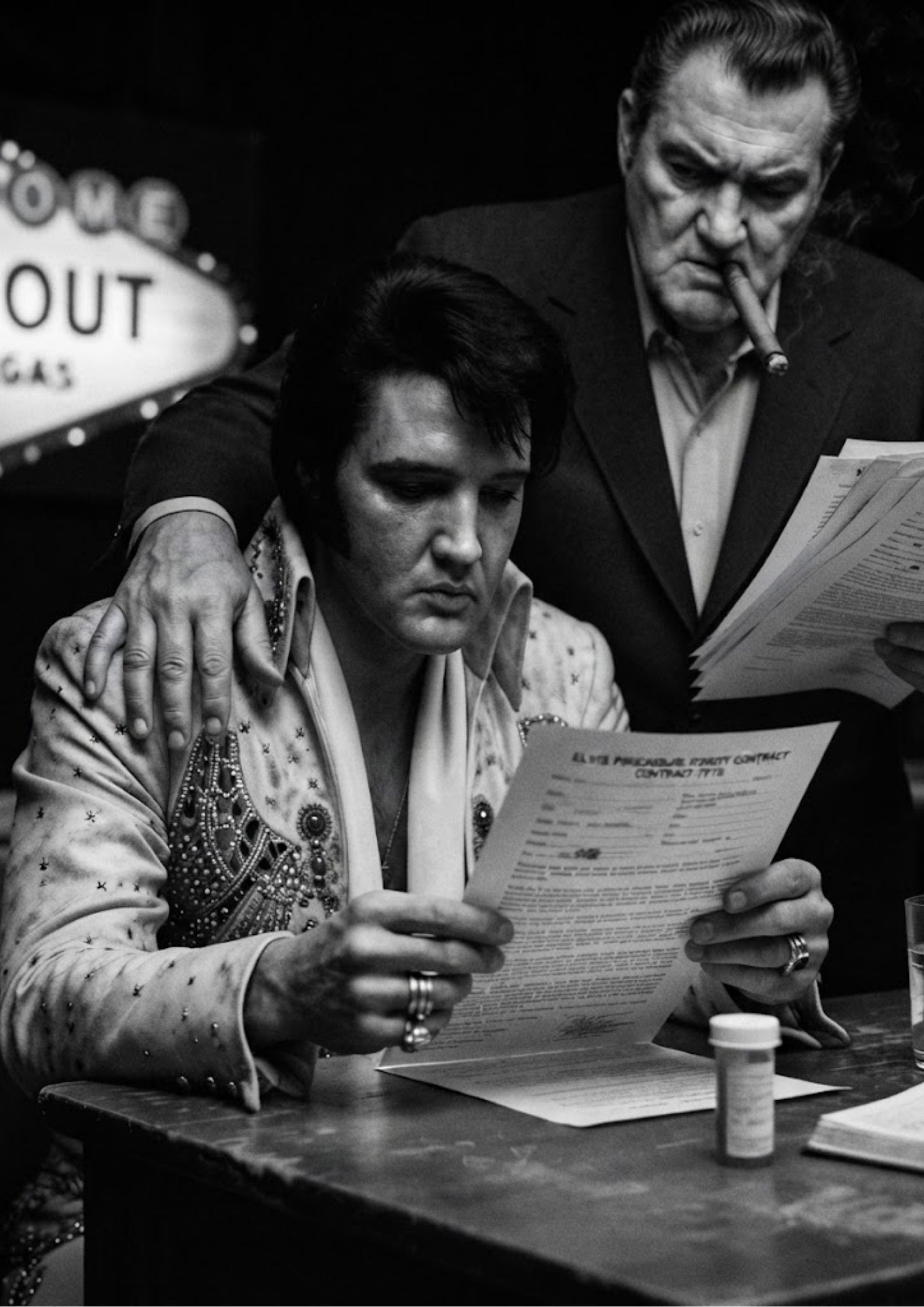
The Historic Shocker: When Elvis Presley’s Glory Was Just a Debt-Paying Tool for a Cruel Manager!
When we look back at the glittering legacy of Elvis Presley, it is easy to become enchanted by the timeless voice, the cinematic milestones, and the adoring roar of millions. Yet, behind the spectacle of the King of Rock and Roll lay a deeply unsettling reality—one orchestrated not by fans or fate, but by the very man trusted to protect his interests. The relationship between Elvis and his manager, Colonel Tom Parker, is one of the most complex and tragic partnerships in music history, transforming a transcendent global superstar into what many close to him described as a financial prisoner.
To understand this gilded captivity, one must look closely at the mechanics of Parker’s management. Parker possessed an uncanny knack for commercial promotion, but his oversight of Elvis’s career was ultimately defined by control and exploitation. As detailed in historical accounts of the era, Elvis completely distanced himself from the business side of his art, leaving all personal finances and contracts entirely up to his father and Parker. Unbeknownst to the public, this abdication of business control allowed Parker to bind the singer to grueling, unrelenting schedules—most notably the exhaustive Las Vegas residency contracts. Elvis grew to deeply resent performing night after night in Sin City, feeling trapped by an endless loop of obligations that felt less like artistic expression and more like a sentence.
The tragedy deepened significantly due to Parker’s own personal demons, particularly a severe, degenerate gambling addiction. Those within the inner circle frequently witnessed Parker losing astronomical sums at casino tables, sometimes dropping millions in a single night. For Elvis, the devastating realization that his grueling performances were essentially being leveraged to pay off his manager’s mounting gambling debts was a bitter pill to swallow. He privately lamented that Parker treated him like a ransom, forcing him back onto the stage not for the love of the art, but to bail out a reckless handler. Furthermore, Parker’s status as an undocumented immigrant meant he steadfastly refused to travel outside the United States, effectively robbing Elvis of the chance to tour internationally and perform for legions of eager fans across Europe and the globe.
For mature audiences and discerning music enthusiasts who remember the unmatched promise of Elvis Presley, the shadow cast by Colonel Parker remains a profound sorrow. Parker didn’t just manage an artist; he built a cage around him, letting apathy and financial leverage dictate the twilight of a legend’s life. By examining this darker chapter, we gain a clearer, sobering perspective on the high price of unmatched fame, remembering the King not just for his extraordinary gift, but for the heavy, unseen burdens he bore until the very end.