Introduction
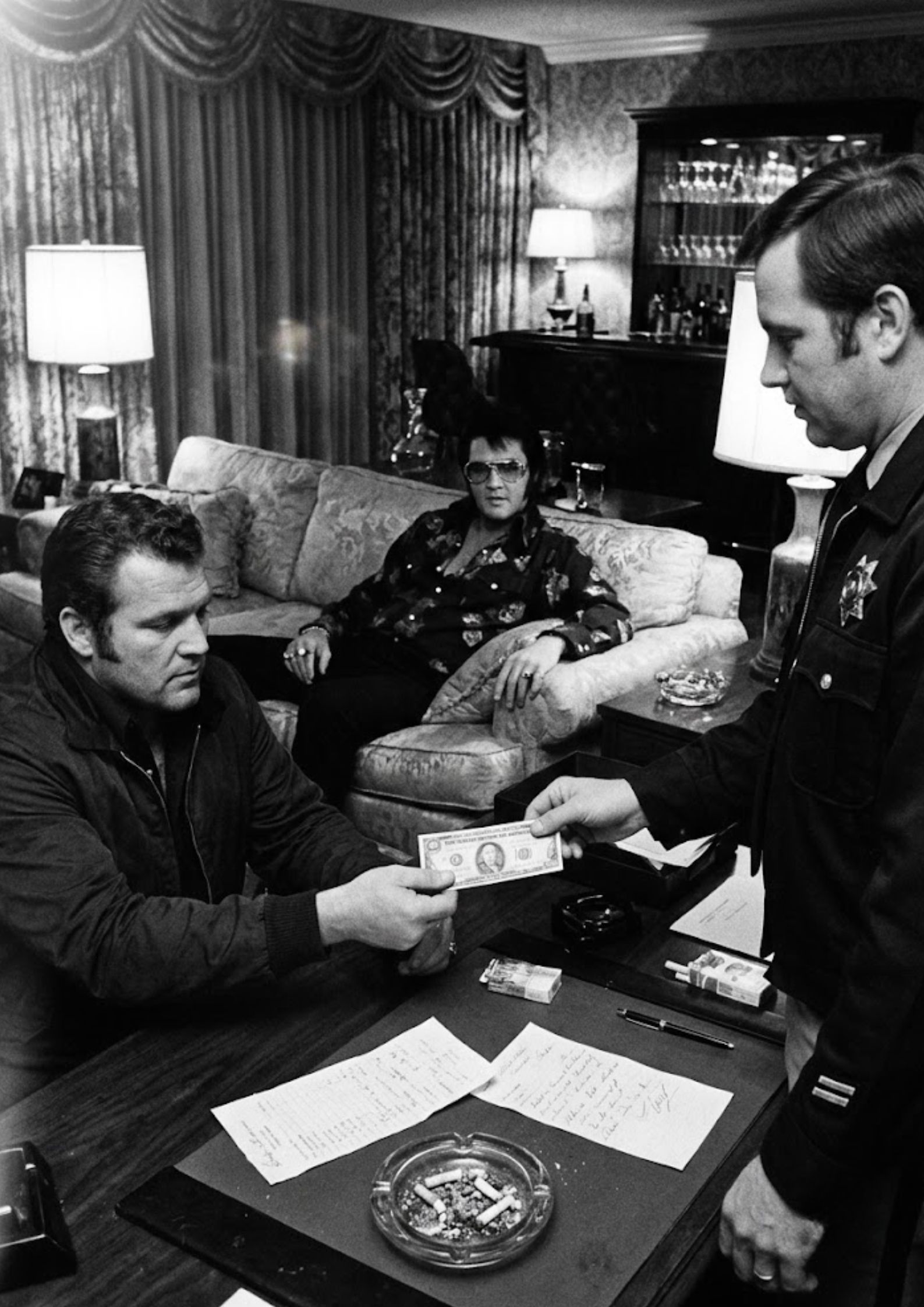
The 30th-Floor Secret: The SHOCKING Story Behind Elvis Presley’s Forgotten $100 Vegas Receipt
During Elvis Presley’s historic engagement at the International Hotel in Las Vegas—later the Las Vegas Hilton—the line separating global superstardom from raw humanity was drawn on the hotel’s 30th floor. Behind fortified security doors, the King of Rock and Roll held court inside a private penthouse suite, insulated from the adoration and mania of thousands below. While the stage saw an untouchable musical icon wrapped in capes and jumpsuits, the suite witnessed the casual, spontaneous eccentricities of a man navigating the crushing isolation of unparalleled fame.
Decades later, an overlooked, weathered scrap of paper emerged from that penthouse retreat: a handwritten receipt detailing a single $100 transaction that unlocked a rarely seen chapter in the King’s inner orbit.
The account belongs to Richard Marino, a hotel security officer on duty during the peak of Elvis’s Vegas residency. While working an ordinary patrol, Marino caught the attention of Red West—Elvis’s trusted confidant, bodyguard, and core member of the famed “Memphis Mafia.” West brought Marino upstairs to handle backstage maintenance, deliver supplies, and clean the suite following a long night of private gatherings.
What unfolded was an intimate glimpse into Presley’s late-night dominion. After observing Marino quietly managing duties across the room, Elvis reportedly turned to West and barked a casual, characteristic directive: “Give Marino 100 bucks!”
To a working-class security guard, the spontaneous tip was an unforgettable windfall. But its true historical resonance surfaced years later, when a handwritten voucher bearing Red West’s signature was discovered, documenting the specific $100 payout. The transaction was further contextualized by correspondence attributed to West’s cousin and fellow bodyguard Sonny West, attempting to authenticate the physical artifact.
While forensic paper analysis and official provenance checks remain essential to establishing whether the document constitutes an undisputed historical relic or a piece of nostalgic ephemera, Marino’s testimony provides something far more valuable than paper: an unfiltered look at how power, generosity, and access functioned inside the King’s closed circle.
Marino’s recollections also peel back the curtain on the tightrope between security and privilege on the 30th floor. In one vivid elevator incident, dozens of persistent fans packed into a car hoping to breach the singer’s floor, only to be stopped cold by armed security. Yet two young women, recognized by suite insiders from earlier visits, were casually waved through the perimeter while the rest of the car was turned back. It was an ecosystem where a nod from an associate like Red West carried more weight than any hotel rulebook.
More than five decades removed from Elvis’s electrifying Vegas years, pop culture often reduces his legacy to sensationalized controversies, pill bottles, and stage theatrics. But records like Marino’s $100 payment restore the human scale of the legend. Through the eyes of an ordinary hotel employee summoned to the top floor, Elvis Presley wasn’t just a myth carved in marble—he was a tired, generous monarch ruling over a smoky penthouse suite, distributing hundred-dollar handshakes in the quiet hours before dawn.