Introduction
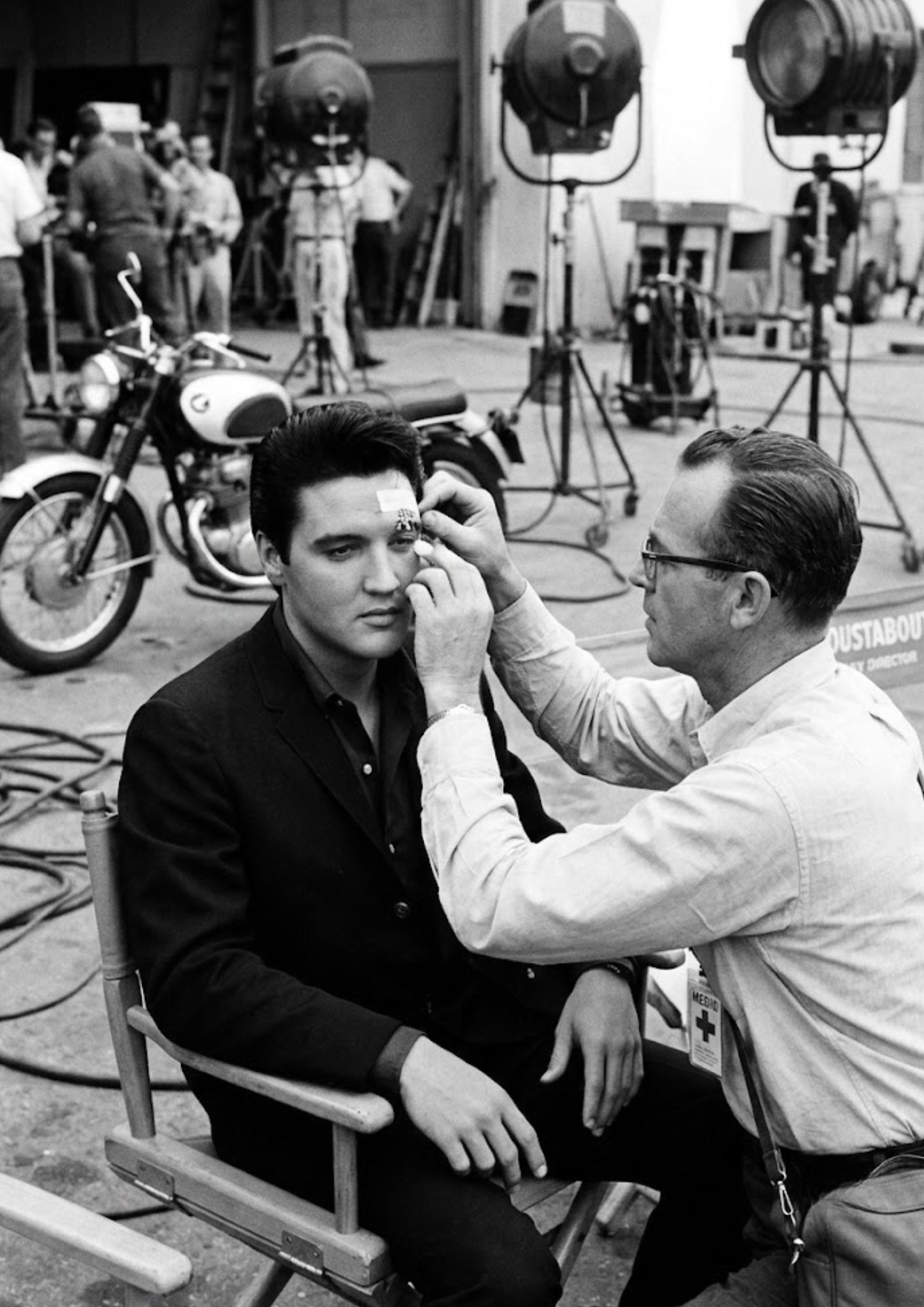
Hidden in Plain Sight: The SHOCKING Story Behind the Real Blood on Elvis Presley’s Face
When audiences sat down in late 1964 to watch Roustabout, Elvis Presley’s sixteenth feature film, they were treated to standard Hollywood escapism: a leather-jacketed carnival singer, flashy musical numbers, and a dramatic motorcycle spill that left the protagonist nursing a stitched-up forehead. For generations of moviegoers, the bandage worn by Presley’s character, Charlie Rogers, was simply another costume prop designed to advance a predictable plotline.
In reality, the bandage wasn’t movie magic. It was concealing nine surgical stitches—the result of a real on-set collision that the studio frantically wrote into the script to avoid shutting down a multimillion-dollar production.
The incident occurred in March 1964 during the filming of an elaborate tavern brawl. While major Hollywood studios routinely required their most valuable leading men to step aside for professional doubles, the 29-year-old Presley had other ideas. Having immersed himself in martial arts during his military service in West Germany in 1958, Elvis was eager to showcase his genuine hand-to-hand combat skills. He reportedly convinced director John Rich to let him perform the complex fight choreography without a stunt double.
The decision proved nearly disastrous. Across from Presley stood Glenn Wilder, then an up-and-coming stuntman establishing his credentials in Hollywood. During a chaotic exchange of kicks and falls, the choreography broke down. A stray heel caught Presley squarely above the eye, opening a deep, bleeding laceration.
On a set run by Paramount Pictures, the injury created immediate panic. With a bleeding star, strict studio deadlines, and daily overhead costs mounting, halting production for weeks while Elvis healed was an economic nightmare.
The studio’s solution was swift, cynical, and brilliant: rewrite the screenplay overnight. As documented in a Daily Variety report from March 17, 1964, the production team devised an impromptu motorcycle crash to justify the star’s bandaged forehead on camera. By disguising a real medical emergency as a fictional plot point, the cameras kept rolling, leaving global audiences completely unaware that the blood and stitches were genuine.
Yet, behind the studio’s clever cover-up was an equally compelling human dynamic. According to accounts later attributed to Memphis Mafia member Sonny West, members of Elvis’s protective entourage were furious, ready to direct their anger at Glenn Wilder for injuring the King. Elvis reportedly intervened immediately, shutting down any retaliation and taking full accountability: he was the one who had insisted on doing the stunt himself.
While that backstage defense remains an oral tradition within the Presley circle rather than a sworn legal affidavit, it aligns closely with the career arc of those involved. Wilder was not blacklisted; instead, he went on to become one of the industry’s most legendary stunt coordinators, co-founding Stunts Unlimited in 1970 and later receiving a Lifetime Achievement Award from the Taurus World Stunt Awards in 2012.
Decades later, the small patch of gauze on Charlie Rogers’ forehead in Roustabout stands as an enduring emblem of mid-century Hollywood filmmaking. It is the artifact of an era where a superstar’s obsession with doing his own fighting nearly derailed a picture, forcing a studio to hide nine stitches in plain sight—and turning a real brush with danger into celluloid myth.