Introduction
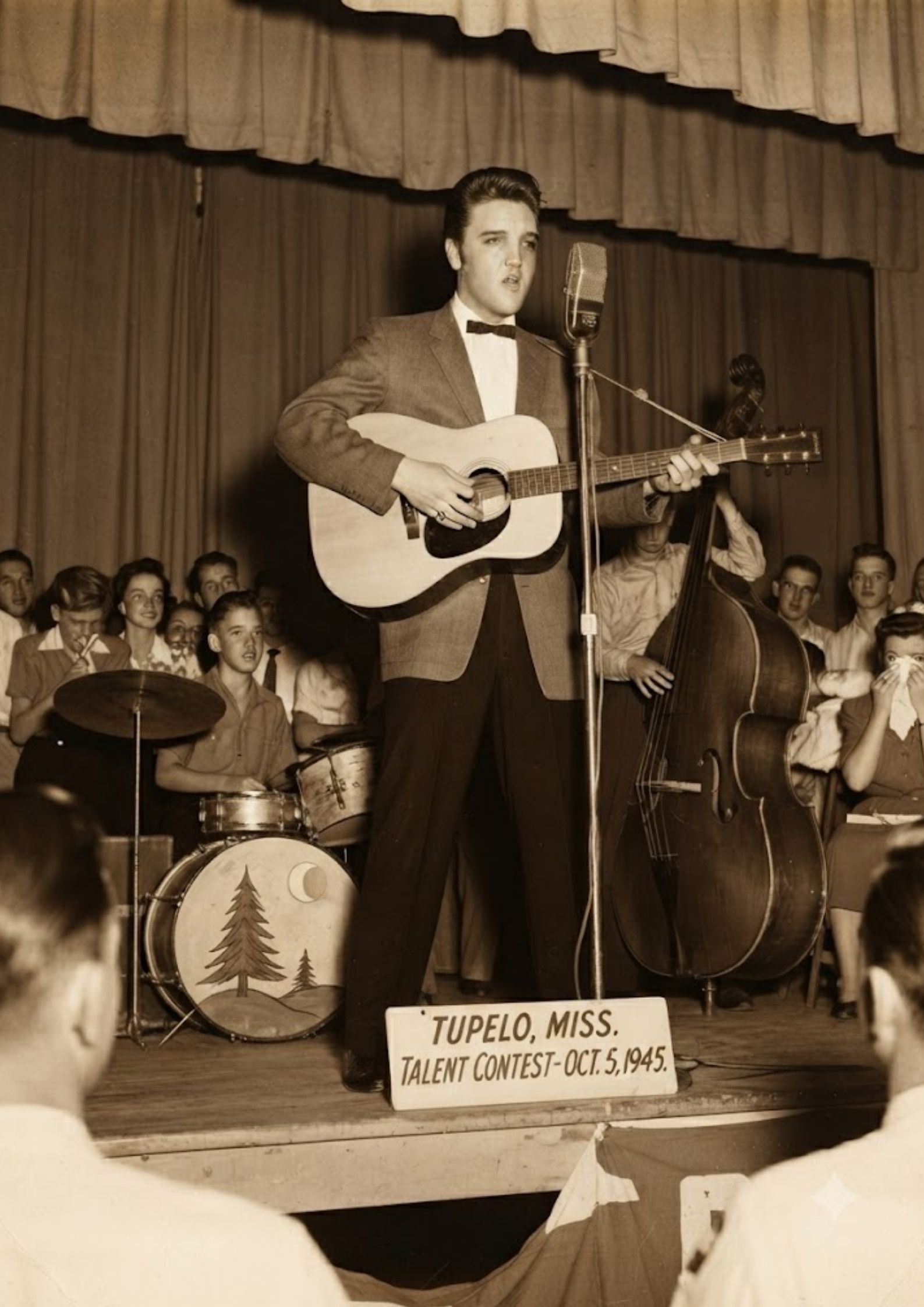
The $12.95 Guitar and a Mother’s Sacrifice: The Secret Roots Behind Elvis Presley’s Legend!
For those of us who have spent a lifetime appreciating the profound evolution of American popular music, the name Elvis Presley evokes images of roaring stadiums, glittering Las Vegas spotlights, and cultural omnipresence. Yet, to truly understand the man who would become the King of Rock and Roll, we must journey far back to a chapter of his story that is frequently overshadowed by later fame: his hardscrabble, deeply formative early years in Tupelo, Mississippi.
Long before the gold-plated tuxedos and the global television broadcasts, Elvis Aaron Presley entered the world on January 8, 1935, in a modest two-room house built by his father Vernon and grandfather on Old Saltillo Road. Born alongside his identical twin brother Jesse Garon, who sadly did not survive childbirth and was laid to rest in an unmarked grave, Elvis grew up in a world defined by the quiet struggles of the American Deep South. For the poorest families navigating the economic hardships of that era, life was a daily exercise in resilience, hard work, and survival.
Yet, within those humble and challenging surroundings, a rich cultural tapestry took root. Segregation largely defined the social structures of the region, keeping communities apart, but music and faith transcended those rigid boundaries. From the age of two, young Elvis was immersed in the powerful, emotive sounds of gospel music at the First Assembly of God church located just a block from his home. He absorbed the spiritual intensity of religious revivals and tent meetings, observing how preachers moved their congregations with rhythm and vocal expression—elements that would heavily influence his own magnetic stage presence decades later.
Music was not merely an entertainment form in those formative years; it was a lifeline. When Elvis was thirteen years old, his mother, Gladys, made immense personal sacrifices, saving for months to afford the $12.95 price tag to purchase his very first guitar. Sitting closely by the family radio, the young boy meticulously learned to play, absorbing the heartfelt laments of country stars like Roy Acuff and Ernest Tubb, alongside blues singers like B.B. King. These disparate musical streams merged seamlessly within his developing artistic consciousness, laying the foundational groundwork for a completely revolutionary sound.
Reflecting upon these early Mississippi roots allows mature, discerning audiences to appreciate the true essence of Elvis Presley’s legacy. Behind the colossal commercial machine of his later career lay the soul of a quiet, sensitive southern boy shaped by gospel hymns, a mother’s devotion, and the unyielding spirit of a simpler time. His journey proves that the greatest artistic legends often emerge from the most unassuming and quietest corners of the American landscape.