Introduction
The Fortress of Graceland: Inside the Turbulent 18 Months That Nearly Broke Elvis Presley Before He Built an Empire
History remembers 1956 and 1957 as the triumphant blitzkrieg that crowned Elvis Presley the King of Rock and Roll: chart-topping singles, Hollywood cinema debuts, and historic television ratings. Yet, behind the manic public hysteria lay a far more precarious reality. In the eighteen turbulent months spanning late 1956 to mid-1957, the twenty-one-year-old phenom found himself caught in a punishing crosscurrent between astronomical commercial ascent, the fragile health of his mother, the looming shadow of the military draft, and an escalating need to erect a private sanctuary before the outside world consumed him completely.
The pace was relentlessly disorienting. In autumn 1956, Presley moved seamlessly from hosting screen sirens like Natalie Wood in the rhythm-and-blues underground of Memphis to the incandescent spectacle of Las Vegas showrooms. Yet, beneath the veneer of emerging royalty, he remained deeply rooted in the working-class soil that birthed his craft. Days after screening his cinematic debut, Love Me Tender, Elvis walked into Sun Studio on December 4 for what began as a routine visit, only to spark the legendary, unscripted Million Dollar Quartet session alongside Johnny Cash, Carl Perkins, and Jerry Lee Lewis. On weekends, he was still slipping away to the dirt lots of the Dave Wells Community Center, playing tackle football with neighborhood friends to touch something real before the cameras found him again.
The pressure reached an agonizing boiling point in early 1957. On January 4, an Army physical confirmed that national service was imminent; two days later, Ed Sullivan’s censors infamously banned his hips from American living rooms. Far more harrowing, however, was the sudden hospitalization of his beloved mother, Gladys, on January 27. The family’s modest home on Audubon Drive had become a fishbowl, besieged by thousands of fanatical onlookers camping on the lawn. Trapped between a skyrocketing Hollywood schedule filming Loving You and the deteriorating sanctuary of his family, the need for an escape was no longer a luxury—it was a survival mandate.
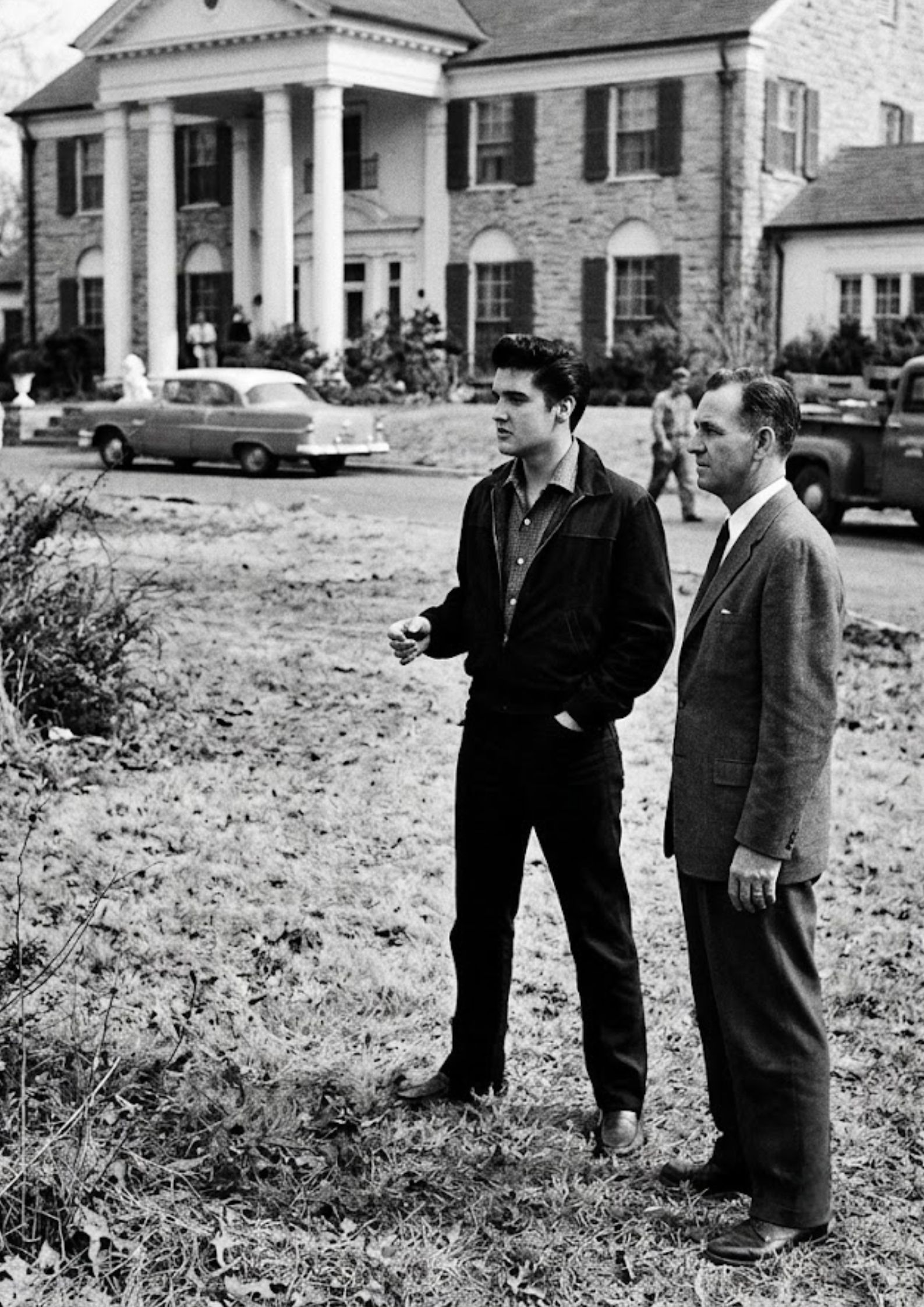
The answer arrived on March 19, 1957, when Elvis signed a $1,000 deposit on a rural estate in Whitehaven, Tennessee, securing the grand colonial property known as Graceland for $102,500. Graceland was never intended merely as a playground of eccentric wealth; it was designed as a fortress. Behind its newly welded musical gates, Elvis sought to shield an ailing Gladys, house his inner circle, and preserve a private Eden away from the suffocating machinery of the entertainment industry.
When Elvis finally slept his first night at Graceland in late June 1957—fresh from shooting Jailhouse Rock and with his final pre-induction concerts looming—the foundation of his enduring myth was set. Graceland was the physical manifestation of a young man’s desperate effort to keep his family grounded amid a cultural hurricane. Decades later, as millions walk through those iconic iron gates, the mansion stands not merely as a shrine to mid-century rock excess, but as an enduring monument to a son who conquered the world just to build a sanctuary for the people he loved.