Introduction
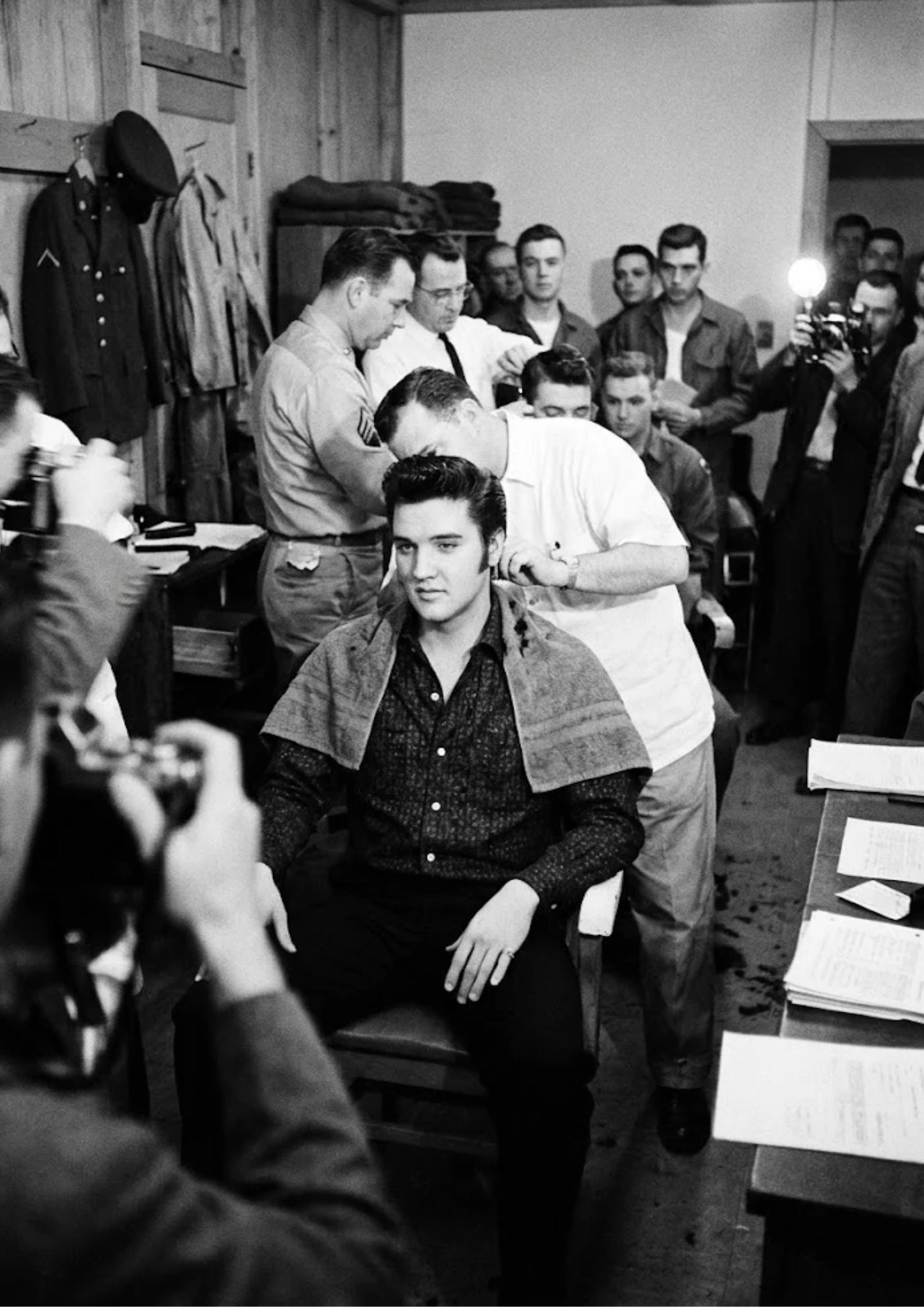
The Great Disruption: How the U.S. Army Stripped Elvis Presley of His Identity—and He Liked It
On March 24, 1958, the most disruptive force in American popular culture was marched into a military induction center, fingerprinting ink staining the hands that had electrified a generation. Elvis Presley’s enlistment into the United States Army was not a calculated publicity stunt; it was a seismic pause that threatened to permanently dismantle the lucrative, rebellious empire of the King of Rock and Roll. At the peak of his cultural and commercial power, the twenty-three-year-old was stripped of his trademark sideburns, his guitar, and his freedom, trading the hysteria of screaming crowds for the anonymous discipline of military boots. Behind this historic transition lay a high-stakes gamble that would either destroy his career or solidify his myth.
To a skeptical public, the spectacle of “Private Presley” at Fort Chaffee, Arkansas, seemed like a bizarre national experiment. The military, eager to prove its egalitarian principles, treated him as just another recruit, while the press hovered relentlessly, hunting for cracks in his composure. Yet, what the rare archives of his 1958–1960 service reveal is not a defeated rebel, but a remarkably strategic young man who used the barracks to re-write his narrative. Under the intense gaze of the media, Elvis defended his music against lingering accusations of juvenile delinquency, gracefully disarming critics by embracing the conformity of the draft with a quiet, unexpected dignity.
In Germany, far from the insular shielding of his Memphis entourage, Elvis faced an entirely different kind of crucible. He would later reflect that the harsh realities of service—and the shared hardships with ordinary young men—offered a grounding that his meteoric fame never could. It was during this period of displacement, while coping with the devastating loss of his mother, Gladys, and navigating the discipline of overseas deployment, that he met a young Priscilla Beaulieu, an encounter that would forever alter his personal trajectory. Far from a lost era, the military became a transformative purgatory where Presley shed his dangerous, hip-swiveling notoriety to emerge as a patriot.
When Sergeant Presley was honorably discharged in March 1960, the rebellious youth of 1957 was gone, replaced by a mature, national figure who was welcomingly received by the very establishment that had once feared him. His post-service debut in the film G.I. Blues was not a return to his raw, rockabilly roots, but a celebration of his new, citizen-soldier persona. The draft, which many predicted would bury him, had instead humanized the icon, transforming a controversial teenage idol into an untouchable American institution. Decades later, the images of Elvis in uniform endure as a testament to the night the music stopped—and the soldier who proved that even the King could serve.