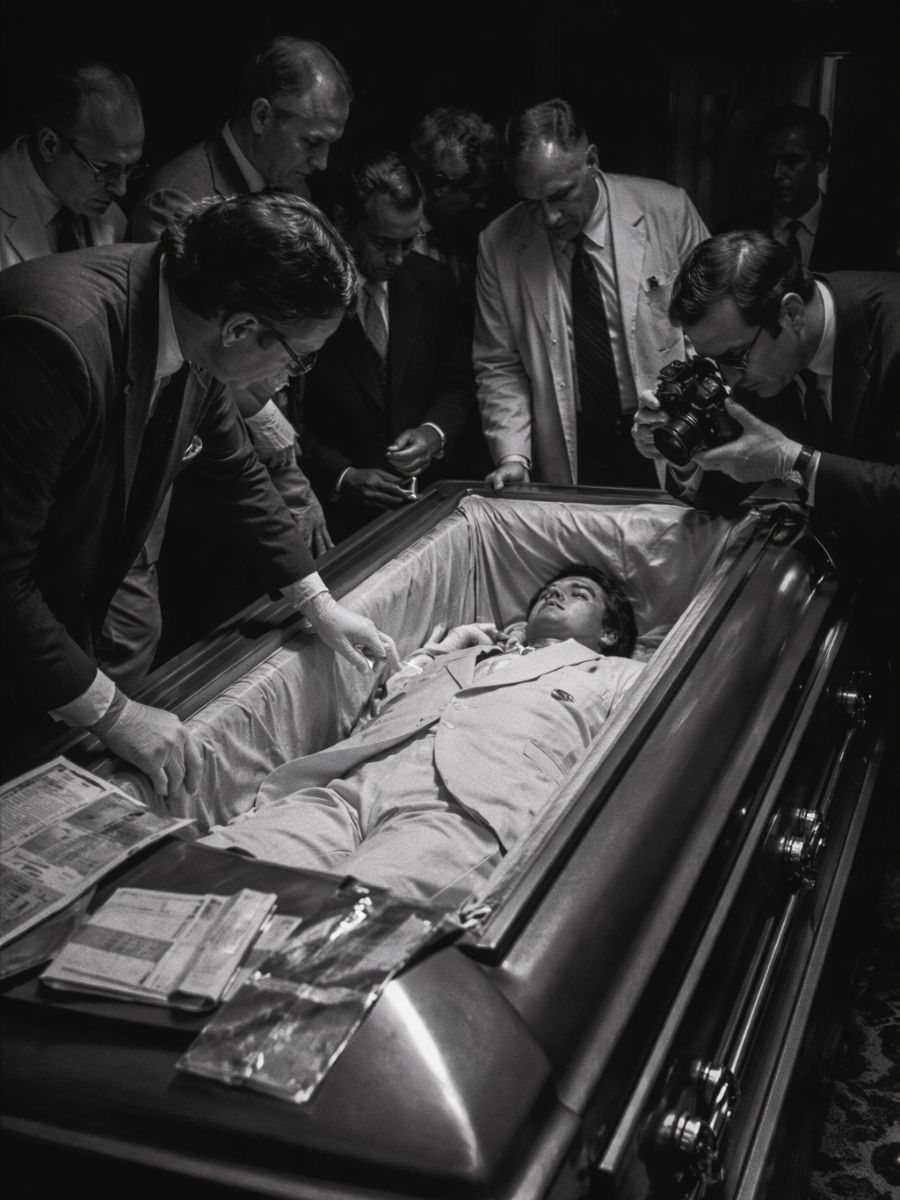
“They Opened Elvis’s Casket After 30 Years… What They Found Was Never Meant to Be Seen”
For decades, the world believed it knew how Elvis Presley’s story ended.
A quiet afternoon. A tragic loss. A legend gone too soon.
But some stories are too clean. Too simple. Too… convenient.
And sometimes, the truth doesn’t stay buried.
—
It began with a moment of panic. A race home. A phone that wouldn’t stop ringing. The kind of moment that feels ordinary—until you realize it’s connected to something much bigger. Something that would take more than 30 years to even begin to unravel.
On August 16, 1977, the world fell silent as news spread that Elvis Presley had been found unresponsive inside Graceland. Within hours, an official explanation was delivered: heart failure. A sudden end to a legendary life.
The media accepted it. The public mourned. And history… moved on.
But behind closed doors, not everyone was convinced.
The original medical findings were released with unusual speed. Questions lingered. Details remained unfinished. Yet the conclusion was presented as final—neat, unquestioned, and widely accepted.
For years, those who raised concerns found themselves drowned out—not by facts, but by noise. Wild rumors and outlandish theories overshadowed legitimate questions. And slowly, the real discussion disappeared beneath the surface.
Until, decades later, something changed.
—
Nearly 30 years after the funeral, a quiet process began.
No headlines. No cameras. Just documents, requests, and a small group of individuals with the authority to ask questions that had long been avoided.
And then—the unthinkable happened.
The casket was opened.
—
What followed was not a spectacle. It was controlled. Clinical. Careful.
But what was discovered inside that room didn’t just revisit the past—it challenged everything people thought they knew.
Forensic specialists began documenting what time had preserved. And almost immediately, certain details didn’t align with the long-accepted timeline of Elvis’s final hours.
Subtle markers suggested something different.
Not dramatically—but enough to raise eyebrows among those trained to notice what others would miss.
And then came something even stranger.
Personal items—objects that had never been publicly recorded as part of the burial—were found inside the casket. Items no official report had ever mentioned. Items no one could fully explain.
Among them… a handwritten note.
Sealed. Private. Directed not to the world—but to someone specific.
Its full contents have never been publicly revealed.
But its presence alone raised a powerful question:
Who had access… and why was it never documented?
—
As the examination continued, another layer emerged.
Traces—subtle but significant—suggested a more complex picture than the official narrative had ever acknowledged. Not a contradiction, but an expansion. A deeper, more complicated version of events that had never reached the public.
And just as quickly as the process began…
It ended.
—
Within days, those involved were contacted. Agreements were presented. Conversations were quietly redirected. What had been discovered didn’t become headlines—it became something else entirely.
Contained.
Managed.
Silenced.
—
For decades, the story of Elvis Presley’s final days has been carefully told—a narrative polished, simplified, and repeated until it became accepted truth.
But what if that version was only part of the story?
What if the real picture was more complicated… and far less comfortable?
—
This isn’t about conspiracy.
It’s about questions.
About timing. About missing details. About decisions made behind closed doors.
Because when a legacy becomes an empire, the story isn’t just history anymore…
It’s a product.
And sometimes, the truth is the one thing that doesn’t fit the brand.
—
The casket was opened.
Something was found.
And whatever it was… it was never meant to be part of the story you were told.