Introduction
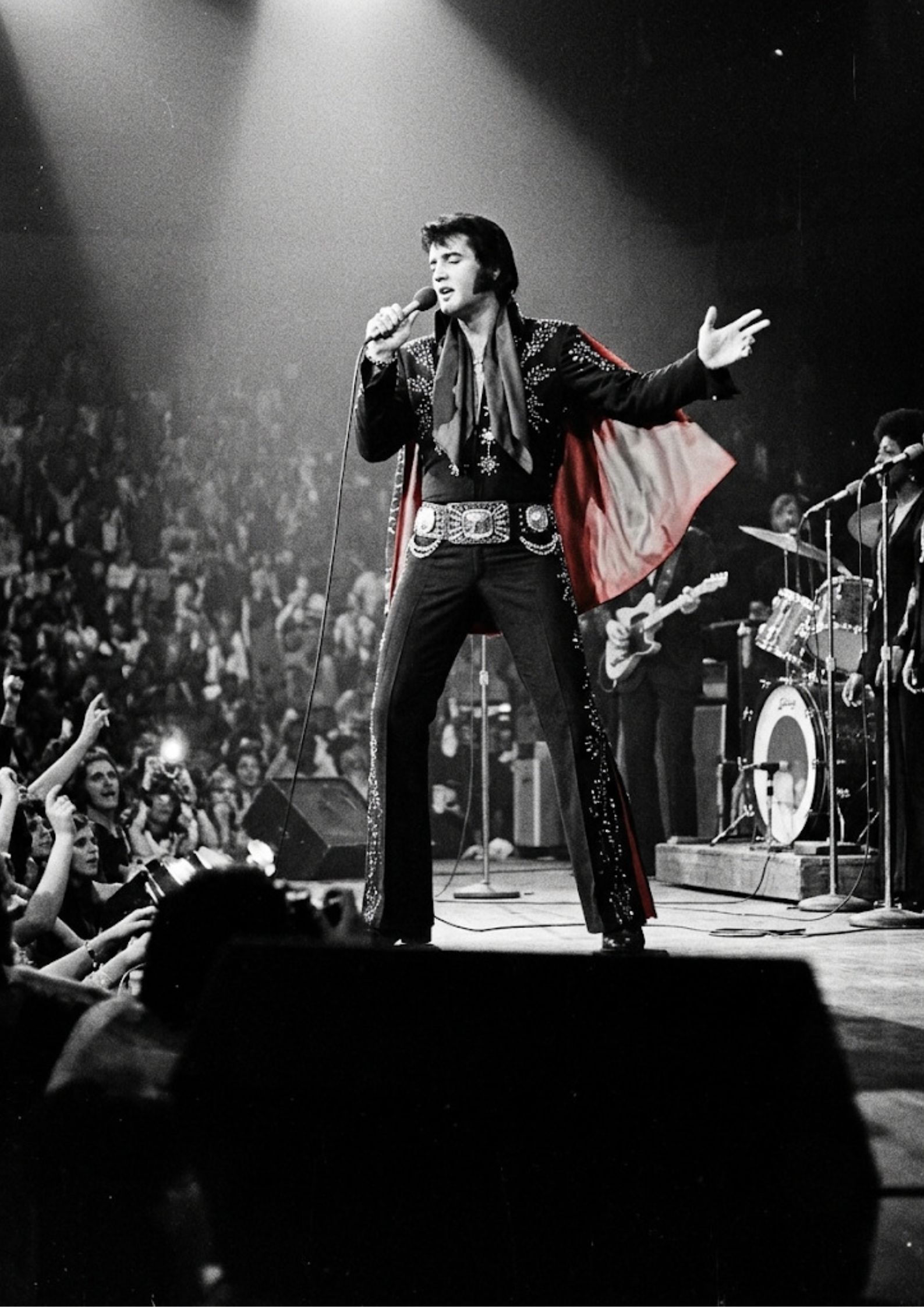
The Singular Surge: INSIDE THE EXPLOSIVE NIGHT Elvis Presley Conquered Boston Garden—And the Unearthed Artifacts Marking Its 55-Year Legacy
BOSTON, MA — On the night of November 10, 1971, the humid, cavernous rafters of the old Boston Garden shook with a deafening roar that had nothing to do with the Bruins or the Celtics. For exactly ninety minutes, the storied North Station arena became the epicentre of American popular music.
Draped in an obsidian two-piece stage suit accented with a dramatic lined cape and intricate gold hardware, Elvis Aaron Presley stepped into the spotlight.
It would stand as his first, his last, and his only live concert appearance in the city of Boston.
Fifty-five years later, that solitary evening remains an electric, mythic outlier in rock history—now brought into sharp, forensic focus through rare archival recordings, critical retrospectives, and an exhaustive photographic chronicle that immortalizes the King of Rock and Roll at the peak of his touring superpowers.
The Apex of the Live Machine
To grasp the magnitude of that autumn night in 1971, one must look beyond the caricature of Presley’s later decline. Following his seismic, black-leather resurrection in the ’68 Comeback Special and his triumphant 1969 return to live stages at the International Hotel in Las Vegas, Presley had re-engineered his craft.
By late 1971, he was not merely an entertainer; he was the leader of the most lethal touring ensemble in America. Backed by the thunderous precision of the TCB Band—anchored by master guitarist James Burton, drummer Ronnie Tutt, and conductor Joe Guercio’s soaring brass section—Presley treated arena tours not as nostalgic revivals, but as full-throttle musical revival meetings.
When the house lights dropped inside Boston Garden, the 15,000 fans packed into the rafters were greeted by an artist in absolute physical and vocal prime.
Kicking off with the blistering rockabilly tempo of “That’s All Right,” Presley tore through an eclectic setlist that defied genre boundaries: the swamp-rock rhythm of “Proud Mary,” the earth-shaking gospel intensity of “How Great Thou Art,” the orchestral melodrama of “Bridge Over Troubled Water,” and the frantic, sweaty climax of “Suspicious Minds.” He moved fluidly between feral rock instincts and operatic grace, holding the Garden in the palm of his hand.
Critical Rapture: Converting the Skeptics
Presley’s whirlwind tour did not merely hypnotize swooning fans; it systematically disarmed a notoriously cynical East Coast press corps.
Reporting from the press box, Ernie Santosuosso of The Boston Globe captured the sheer pandemonium in the hall, remarking on the generational mania that swept through an arena usually reserved for ice hockey brawls.
More crucially, the performance caught the ear of rising rock critic Jon Landau. Just years before he would discover Bruce Springsteen and declare him “rock and roll future,” Landau wrote his legendary, reverent essay “In Praise of Elvis Presley”, dissecting the sheer genius of Presley’s stage economy. Landau observed an artist who completely understood the theatrical and cultural mechanics of American pop—a singer whose command of irony, timing, and raw vocal resonance proved he was still the supreme architect of the genre.
The Forensic Lens: One Night in Boston
For decades, the sensory details of that solitary New England gig survived primarily in local lore and grainy bootlegs. That changed with the release of ELVIS: One Night in Boston, November 10, 1971, authored by renowned Norwegian researcher and archivist Erik Lorentzen.
Spanning roughly 146 pages of archival photography, the volume strips away the mythic blur to provide an intimate, frame-by-frame anatomy of the concert. Every frame exposes the nuance lost to time: the sweat glistening on the lapels of his cape, the intense, predatory focus in his eyes as he locks onto the rhythm section, and the explosive physical karate stances that punctuated his musical cues.
Unlike broad retrospective biographies that skim Presley’s career in sweeping generalities, Lorentzen’s hyper-focused archive serves as an essential historical artifact. It captures Presley in an era when his charisma was effortlessly lethal and the sheer joy of live performance remained untainted by the exhaustion that would soon claim his final years.
The Sonic Twin: Boston Garden ’71
The visual record received its ultimate sonic complement when Follow That Dream (FTD)—Sony’s elite collectors’ imprint—officially mastered and released the soundboard tapes under the title Boston Garden ’71.
Sourced from the mixing desk on that November evening, the recording strips away the cavernous echo of the arena, revealing a raw, punchy document of a vocal powerhouse in full flight. Presley’s baritone cuts through the dense arrangements with razor clarity, completely debunking the notion that his 1970s concert career was an exercise in hollow showmanship.
An Unrepeatable Convergence
Why does a single concert played fifty-five years ago continue to command such fierce devotion?
Because it represents an unrepeatable alignment of time, place, and presence. Boston never saw Elvis Presley again. There were no return engagements, no late-career farewells, and no second acts under the Garden rafters.
The fans who filed out onto Causeway Street into the brisk November chill that night carried with them the memory of a singular lightning strike. Half a century later, through the combined magic of unvarnished photography, pristine soundboard audio, and vivid contemporary reporting, the lights inside Boston Garden never truly went out. The King took the stage once—and Boston never forgot it.
Were you or someone in your family lucky enough to be in the audience inside Boston Garden that chilly November night in 1971? Looking across his career, do you think his early 1970s arena tours represented the pinnacle of his vocal and physical power, or does the raw 1950s rebel remain your definitive King? Share your memories and thoughts in the comments below!