Introduction
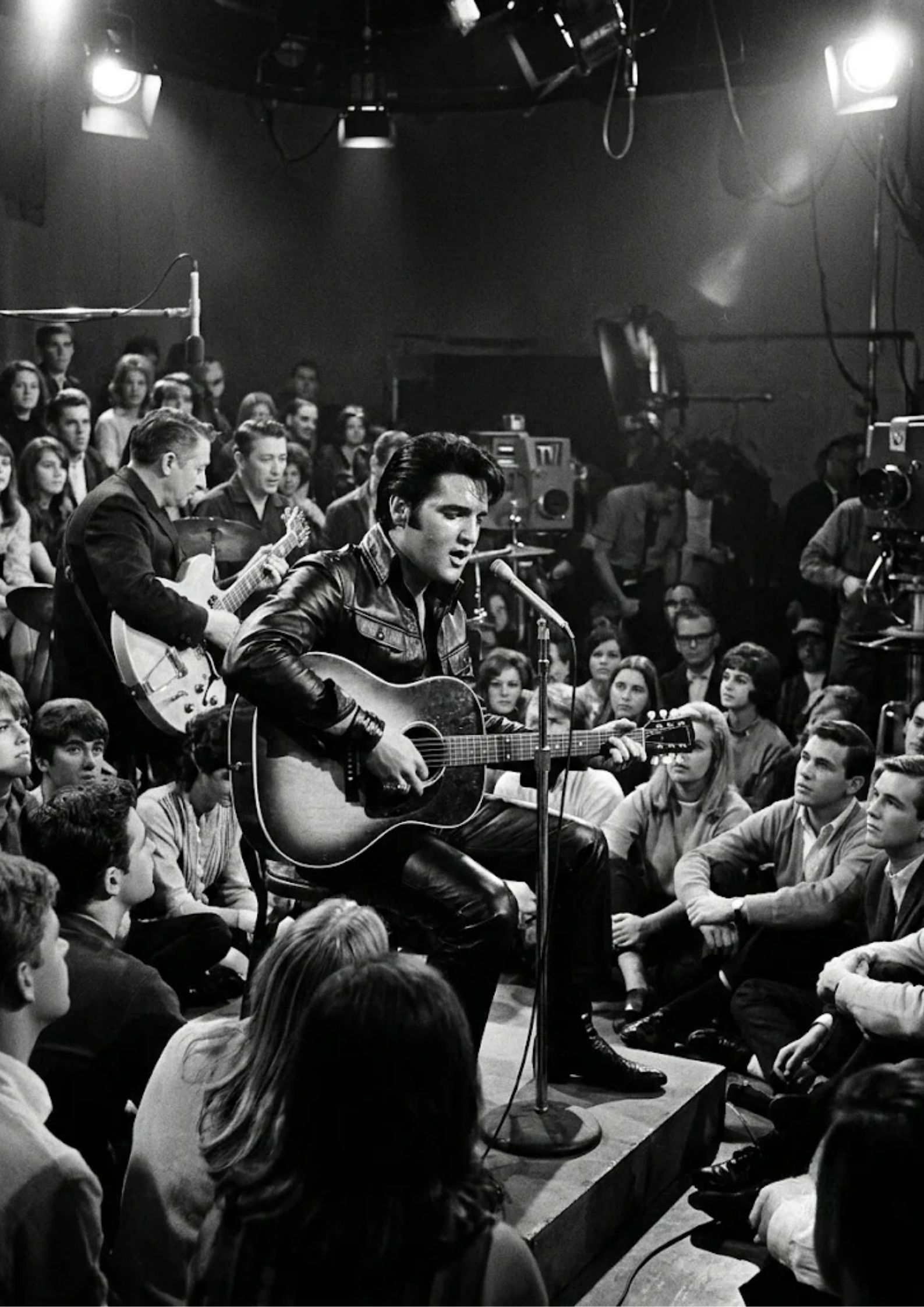
The Phoenix Reborn: The Secret 1968 ‘Coup’ That Resurrected the Throne of Elvis Presley
By 1968, history had all but written Elvis Presley’s obituary while he was still alive.
The man who once overturned American culture with his rebellious hip-shaking, the artist who had defined Rock ‘n’ Roll itself, had been reduced to a tired, Hollywood cash cow. For eight grueling years, under the iron-fisted management of Colonel Tom Parker, Elvis was locked into a monotonous conveyor belt of 31 cheap musical comedies, churning out lifeless studio soundtracks.
The world outside had moved on. The Beatles spearheaded the British Invasion, Bob Dylan injected intellectual grit into the anti-war movement, and Woodstock was steadily taking shape. As counterculture exploded across America, the King of Rock ‘n’ Roll was treated as an irrelevant relic—safely insulated by Hollywood, but completely defanged.
Yet on the night of December 3, 1968, history was rewritten on NBC television. It was far more than an ordinary variety show; it was an artistic coup d’état—a life-or-death battle for Elvis Presley’s musical soul, orchestrated alongside a defiant young director named Steve Binder.
The Silent Mutiny Against Colonel Parker
When NBC and sponsor Singer approached the camp with an offer for a 1968 holiday special, Colonel Tom Parker already had an airtight commercial formula mapped out: Elvis would sport cozy holiday sweaters, stand among twinkling Christmas decorations, sing “Blue Christmas,” and offer warm seasonal greetings to American living rooms. It was safe, profitable, and quintessentially formulaic.
Steve Binder, the 35-year-old television director brought on board, had a completely different vision. Looking past the synthetic veneer of the movie star, Binder saw an imprisoned musical beast yearning to break free.
“Elvis, you can keep making these awful movies and fade away, or you can show them who you really are,” Binder bluntly told the King.
Rattled and invigorated by Binder’s candor, Elvis made the perilous choice to align with the director, staging a quiet rebellion against his all-powerful manager. Binder discarded the holiday theme entirely. He wanted Elvis raw, untamed, dangerous, and real.
The crowning stroke of this artistic mutiny was placing Elvis inside a stripped-down, boxing-ring-style stage, surrounded by fans at point-blank range, with no script, no orchestra, and zero room to hide.
Raw Voltage in Black Leather
When Elvis stepped onto the stage clad in form-fitting black leather—masterfully crafted by designer Bill Belew—the studio room caught fire. This was not a costume; it was the battle armor of a warrior reclaiming his territory.
Seated on a modest wooden chair inside the mini-arena alongside his original Sun Records bandmates, guitarist Scotty Moore and drummer D.J. Fontana, Elvis gripped an acoustic guitar and tore into visceral renditions of “That’s All Right,” “Heartbreak Hotel,” and “One Night.”
Audiences witnessed an uncensored Elvis: drenched in sweat, laughing, bantering, sexually charged, and untamed. The stiffness of his Hollywood years evaporated, replaced by the sheer, unbridled fury of pure Rock ‘n’ Roll. The suffocating proximity of the screaming crowd stripped away his hesitation and reawakened the dormant giant within.
Binder later recalled watching through the control-room monitors: “I watched his confidence rebuild frame by frame with every roar from that room. The second he realized they still loved him, he exploded.”
‘If I Can Dream’: A Soul-Baring Cry in a Fractured America
The special was not merely a nostalgic retreat; it was an urgent response to a fracturing nation. The year 1968 was drenched in tragedy, marked by the assassinations of Martin Luther King Jr. and Robert F. Kennedy, alongside the escalating horrors of the Vietnam War.
Binder knew the broadcast demanded a monumental finale, not the jaunty holiday carol Parker insisted upon. He urged vocal arranger and songwriter Earl Brown to pen an impassioned anthem capturing Elvis’s inner grief and hope for his country. The result was “If I Can Dream.”
Upon hearing the demo, Elvis was visibly shaken, declaring: “I’m never going to sing another song I don’t believe in. And I believe in this one.”
For the final sequence, Elvis stood alone before a towering, radiant red neon sign spelling out “ELVIS.” Shedding the black leather for an immaculate white three-piece suit, he seized the microphone and sang as if his life depended on it. Pleading for a world free of hatred, prejudice, and division, his baritone cracked with raw despair and soaring conviction.
The performance reached such transcendent heights that studio personnel in Burbank wept behind the cameras. It was no longer a performance—it was a sacred confession, an artist baring his bleeding soul to the world.
The Reversal of Destiny
When the broadcast—officially titled Elvis and forever remembered as the ’68 Comeback Special—aired on NBC on December 3, 1968, it triggered a cultural earthquake. Garnering an astonishing 42% viewing audience share, it became NBC’s highest-rated show of the year, winning unanimous adulation from critics who had long written Presley off.
The triumph did not merely salvage a career; it forged a glorious second act.
Recharged with artistic purpose, Elvis entered Memphis’s American Sound Studio in early 1969 to cut immortal masterpieces like “Suspicious Minds” and “In the Ghetto,” conquering global charts once again. That same summer, he made his triumphant return to live concert touring at the International Hotel in Las Vegas, delivering 57 consecutive sold-out shows and reasserting his undisputed reign.
The turbulent landscape of 1968 nearly buried an American icon beneath the weight of disposable cinema. But through the collision of Elvis’s suppressed hunger and Steve Binder’s unwavering vision, the King reclaimed his crown. That electrifying night in black leather remains an indelible truth of rock history: you can cage an ordinary man, but you can never shackle a legend.
In your view, if Elvis hadn’t donned that black leather suit and backed Steve Binder to defy Colonel Parker’s safe holiday formula, could he have ever reclaimed his throne—or would he have quietly slipped into the shadows as another Hollywood has-been? Share your thoughts in the comments below!