Introduction
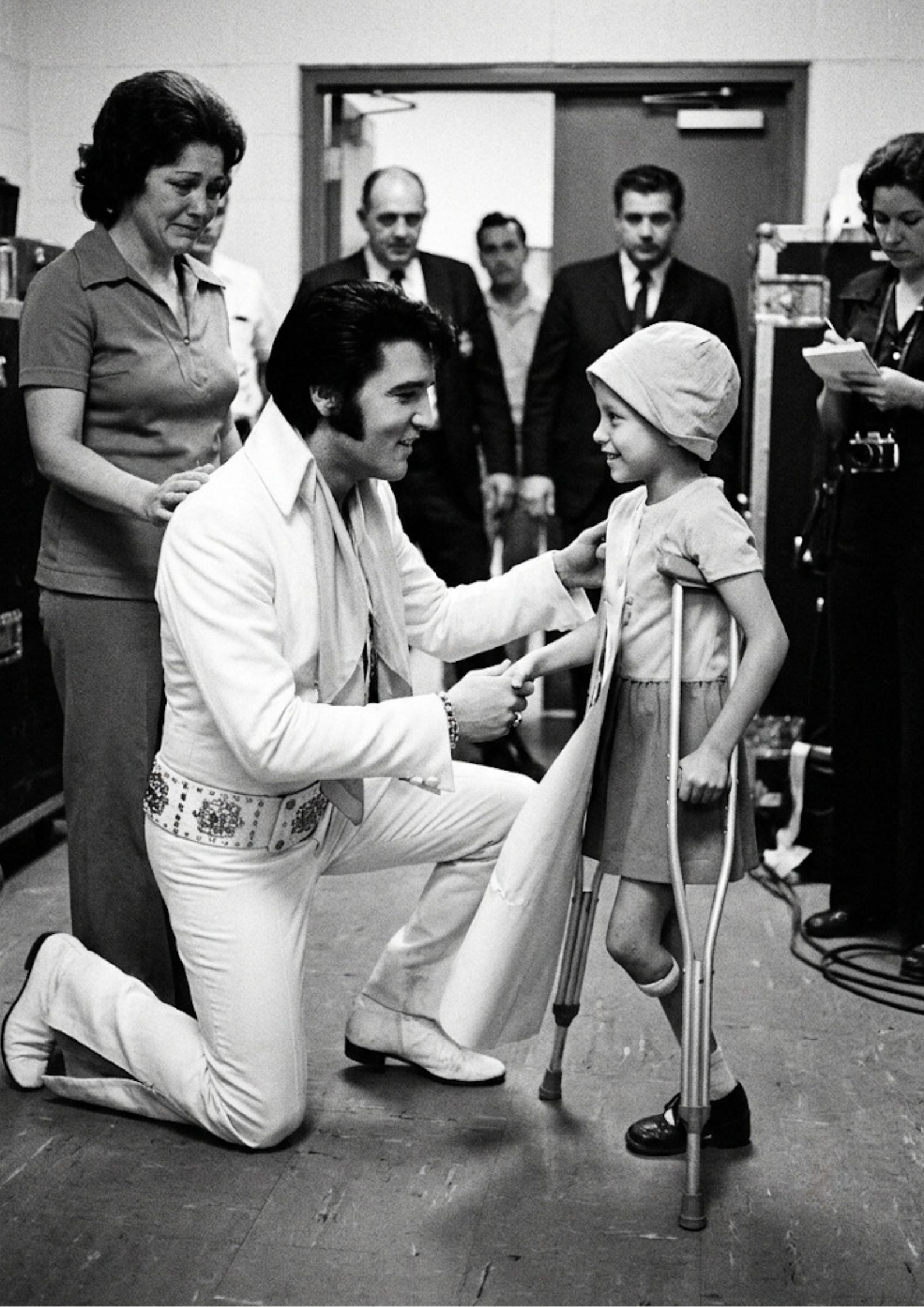
The Mountain He Moved: How Elvis Presley’s Secret Backstage Vow Gave a Dying Eight-Year-Old Her Final Miracle
ALBUQUERQUE, NM — In the spring of 1972, Elvis Presley operated at the absolute center of a deafening, multi-million-dollar hurricane. His sold-out arena tours moved with military precision, shielded by private jets, armed bodyguards, and the ruthless, transactional calculations of Colonel Tom Parker. For an outsider, penetrating that fortress was impossible.
Yet on April 19, inside the echoing corridors of Tingley Coliseum, the King of Rock and Roll halted the entire machinery for an eight-year-old girl leaning on a pair of metal crutches.
Her name was Denise Sanchez. Her body was ravished by terminal leukemia that had spread into her lungs, forcing the surgical amputation of her leg and part of her hip. Doctors in Santa Fe had exhausted chemotherapy and conceded defeat, sending her home on pain management.
What followed in Albuquerque was not a PR stunt or a superficial photo-op. It was an unfiltered, deeply emotional encounter that culminated in a private vow, an unscripted arena dedication, and an innocent, heartbreaking detail that her family would cherish long after the music went quiet.
The Girl Who Chased a Vanishing Dream
In her modest bedroom in Santa Fe, Denise lived surrounded by plaster walls covered in magazine clippings of actors and musicians. But her devotion belonged singularly to Elvis. His records offered a sanctuary—a brief, painless realm where the agonizing realities of cancer ward treatments simply vanished.
Her journey to meet him, however, had been fraught with bitter heartbreak.
While hospitalized in Houston for grueling procedures, Denise learned that Elvis had played the city just days before her arrival. Later, tickets were secured for another stop on his itinerary, only for her condition to plummet overnight, placing her on the critical list. For a child who bore amputations and experimental regimens without tears, missing Elvis was the only injury that truly shattered her composure.
When tour dates confirmed Presley was headed to Albuquerque—scarcely an hour’s drive down Interstate 25—her mother resolved that box seats were not enough. A dying child needed more than a distant glimpse under stage lights; she needed to look her hero in the eyes.
Breaching the Graceland Wall
Gaining private access to the world’s most heavily guarded entertainer required an extraordinary coalition of persistence and compassion.
Grace Marie Prather, a determined reporter with the Albuquerque Journal, caught wind of Denise’s plight and began aggressively working telephone lines into Presley’s inner circle. When the plea finally reached Colonel Parker, the notoriously hard-nosed manager did the unthinkable: he cut through his own red tape.
Parker arranged for Denise, her younger sister Paula, and her mother to meet him at their Albuquerque hotel. He greeted the young girl with genuine warmth, promising her that the King would receive her. Furthermore, Parker arranged for the family to be moved out of their standard seats and placed directly against the edge of the stage apron.
During intermission, the coliseum security parted. Denise hobbled through backstage security doors on crutches, her hands clutching a poster.
When the dressing room door swung open, the icon stepped forward.
Tenderness Behind Closed Doors
Elvis Presley did not offer a rushed handshake. Seeing the frail child struggling on her crutches, he approached her with immediate, disarming tenderness. He kneeled down, smiled, embraced her, and gently kissed her cheek.
Denise, suddenly transformed from a terminally ill patient into an enchanted eight-year-old, eagerly peppered him with questions about Priscilla and four-year-old Lisa Marie. Elvis answered with the patience of a father, chatting warmly with both Denise and her mother before signing her poster with the inscription: “To Denise, Love You, Elvis Presley.”
Before she was escorted back to the floor, Denise looked up and asked for one final thing: Would he sing her favorite song?
Elvis smiled, gave her his word that he would perform something special, but playfully refused to reveal the title.
The Dedication: “You Gave Me a Mountain”
Denise returned to her front-row seat with her heart hammering in her chest.
When the lights dimmed and Presley strode back onto the stage—commanding the room in an ornate white jumpsuit, cape, and blue scarf—the coliseum detonated. But before launching into his customary rhythm, Elvis stepped directly to the microphone and quieted the 12,000 screaming fans with an unscripted announcement:
“This next song is for Denise, a very special girl I just met backstage.”
The band dropped into the opening, solemn chords of Marty Robbins’s “You Gave Me a Mountain.”
As Elvis belted the powerful lyrics about weathering life’s insurmountable tragedies, tears streamed down the faces of Denise’s mother, the reporter, and nearby concertgoers who understood the gravity of the moment. Beside the stage, an eight-year-old who had already climbed an excruciating mountain of physical agony beamed with pure, triumphant joy. The King had kept his promise.
The Kiss She Refused to Wash Away
After the final encore, security guided the family out through an exclusive service tunnel to shield Denise from the crushing crowds. Back home in Santa Fe, relatives flooded the house to hear about the encounter. Denise animatedly recounted Presley’s piercing blue eyes, the flash of his rings, and the softness of his voice.
Yet the most touching, poignant moment unfolded that night at bedtime.
When her mother told her to wash up for sleep, Denise fiercely protested. She adamantly refused to let water or soap touch the cheek where Elvis had placed his lips. For two full days, the eight-year-old proudly guarded that spot, only relenting on the third day when her mother finally insisted.
The magic of her story did not end in New Mexico. Following a feature in Photoplay magazine, a deeply moved couple from Daly City, California—Mr. and Mrs. Larry Miller—underwrote an all-expenses-paid trip for Denise to travel to Nevada and see Presley perform a second time at the Las Vegas Hilton.
A Quiet Legacy Beyond the Charts
Just four months after that luminous night in Albuquerque, Denise Sanchez passed away. She was eight years old.
No rock concert could cure the disease that claimed her life, but that was never the point. In a life truncated by sterile clinics, surgery, and relentless pain, Elvis Presley gave Denise an indelible memory of unconditional dignity, making her feel like the most celebrated person in an arena of thousands.
History routinely measures Elvis Presley by gold records, revolutionary cultural shockwaves, and box-office gross. But the real measure of the man lived in the moments the marquee lights didn’t capture—in the quiet grace of a superstar who stopped the world, kept his word, and helped a little girl carry her mountain.
Stories like Denise’s remind us of the deep, often unrecorded humanity that superstars rarely show the cameras. When you look at Elvis’s later concert years, do moments of personal grace like this redefine how you view his legacy? Share your thoughts and reflections in the comments below!