Introduction
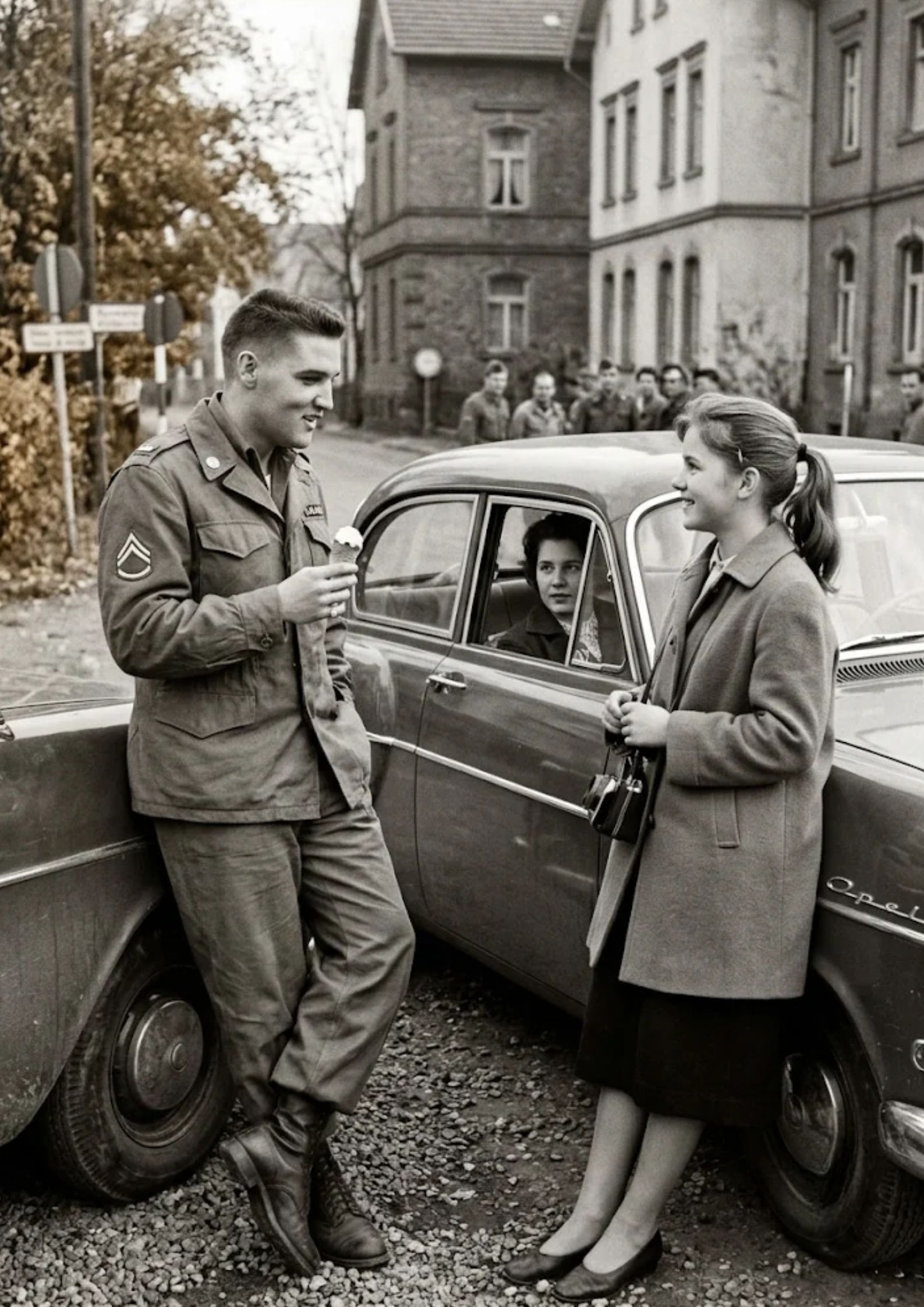
The Erased Muse of Bad Nauheim: DID AN UNTOLD TEENAGE ROMANCE PRECEDE PRISCILLA IN ELVIS PRESLEY’S GERMAN EXILE?
For nearly seven decades, the authorized genesis of Elvis Presley’s domestic mythology has read like an immutable Hollywood script: an exiled, grief-stricken American rock idol, drafted into the U.S. Army and stationed in West Germany, meets 14-year-old Priscilla Ann Beaulieu at an off-base party in September 1959. That encounter launched an eight-year courtship, an iconic Las Vegas wedding, and the birth of Lisa Marie, cementing Priscilla as the singular romantic heroine of the King’s European deployment.
Yet beneath the polished veneer of official estate history lies a shadowy, disputed counter-narrative. For decades, another woman maintained that history had deliberately excised her from the record. Her name was Healey Pimel—later known as Healey Van Westerm—and she claimed that months before Priscilla ever set foot inside Elvis’s Bad Nauheim residence, she was the teenage confidante who shared his private hours, his back-seat confidences, and the emotional wreckage of a superstar stripped of his crown.
Is her account an overlooked chapter of mid-century rock history, or a masterclass in the myth-making that inevitably surrounds an American icon?
The Pre-Priscilla Months: May 1959
When Private First Class Elvis Presley arrived in West Germany in October 1958, assigned to the 3rd Armored Division in Friedberg, he was privately shattered. His beloved mother, Gladys, had died only months earlier, in August, leaving him emotionally anchorless. To escape barracks life, he rented a home at Goethestrasse 14 in the spa town of Bad Nauheim, which rapidly evolved into a bustling salon filled with family, fellow soldiers, local admirers, and hangers-on.
According to Pimel’s personal memoir and accounts, her entanglement with the singer began in May 1959—four months before Priscilla’s documented arrival.
Pimel, then a 15-year-old local girl, described a chance encounter outside his residence that quickly bypassed the usual autograph-hunter protocol. In her telling, Elvis slipped into her sister’s car to evade crowds, sharing ice cream, listening to car radio broadcasts, and trading quiet confidences away from the constant siege of fans. That afternoon allegedly culminated in a clandestine kiss in the back seat—a fleeting, tender gesture from a 24-year-old global celebrity that Pimel claimed signaled a genuine emotional attachment rather than a casual brush with fame.
However, the historical divide here is stark: while Priscilla’s presence in Bad Nauheim was extensively documented by photographers, Army peers, and the Presley inner circle, Pimel’s claimed spring encounters remain entirely reliant on personal recollection, without surviving contemporary logs or third-party confirmation.
Two Teenagers, One Piano: Conflicting Realities
When Priscilla Beaulieu entered the circle at Goethestrasse in September 1959, the official biography presents Elvis as being instantly transfixed. Having been introduced through an airman named Currie Grant, Priscilla became the girl Elvis spent hours speaking with behind closed doors, pouring out his grief over Gladys and his terror that his musical career was dead.
Yet Pimel’s account challenges that immediate, singular coronation. She claimed she remained present within the Bad Nauheim periphery as Priscilla arrived, witnessing evening gatherings where Elvis sat at the piano, working through gospel chords and aching ballads like “Love Me Tender” and “Don’t.”
Where the official narrative sees Elvis performing for Priscilla, Pimel remembered those same melodic glances as being meant for her.
This clash of memoirs underscores a timeless psychological reality of the Presley orbit. Elvis was a musical empath who used intimate songs as currency. He had an innate ability to make every listener in a crowded parlor believe he was singing exclusively to them. Was Pimel misinterpreting the natural, magnetic charm of a southern showman, or was Elvis balancing multiple young companions in the claustrophobic social fishbowl of post-war Germany?
The Paper Trail and the Silent March of 1960
The starkest divergence between the two accounts arrived in March 1960, when Presley finished his tour of duty and prepared to board the USS General George M. Randall back to the United States.
Pimel claimed she wrote letters across the Atlantic that met only silence, leaving her to wonder whether her correspondence was intercepted by the Memphis Mafia or discarded in the flood of fan mail. Her memoir pointed to a March 8, 1960 letter from an acquaintance named Penny, referencing the logistical chaos of Elvis’s departure and the shifting circle of women in Germany—a tantalizing artifact, though one that biographers argue falls short of confirming an enduring romantic pact.
Priscilla, too, endured weeks of anxious silence after Elvis landed at McGuire Air Force Base. The difference was structural: Elvis eventually called. In 1963, Priscilla’s parents agreed to let her move to Graceland under strict guardianship conditions, sealing her path to the altar.
For Pimel, the narrative took an increasingly dramatic, uncorroborated turn. Years later, she claimed an associate connected to Presley’s German circle approached her with messages suggesting Elvis had privately carried affection for her long after leaving Europe—allegations that strayed into speculative territory and, in fringe collector circles, even brushed against debunked survival myths.
Archival Evidence vs. Personal Memory
When examining the competing legacies of Elvis Presley’s German years, historians must weigh two vastly different standards of proof:
-
The Priscilla Record: Anchored by dozens of verified 1959–1960 photographs in Bad Nauheim, contemporaneous Army press interviews, verifiable military records, documented letters, and a legally registered marriage that produced the sole Presley heir.
-
The Pimel Claim: Grounded in a deeply held personal memoir, retrospective interviews, and the subjective interpretation of romantic gestures made within a chaotic, crowded overseas entourage.
Yet historians caution against dismissing the human core of unverified accounts. Elvis Presley in 1959 was lonely, unmoored, and intensely dependent on female validation to soothe his grief. He routinely struck up passionate, short-lived confidences with young women whose names never made the history books.
Whether Healey Pimel was a briefly treasured confidante or a devoted admirer whose memories magnified a passing encounter over decades of reflection, her story highlights the fragile boundary of celebrity history. While history books record the woman who walked down the aisle, the bedrooms and car seats of post-war Germany held many quiet goodbyes that the cameras never captured.
Do you believe Healey Pimel’s account represents an authentic, erased chapter of Elvis Presley’s private life in Germany, or was it the inevitable product of a superstar’s magnetic charm being magnified by memory over decades? Share your view in the comments below!