Introduction
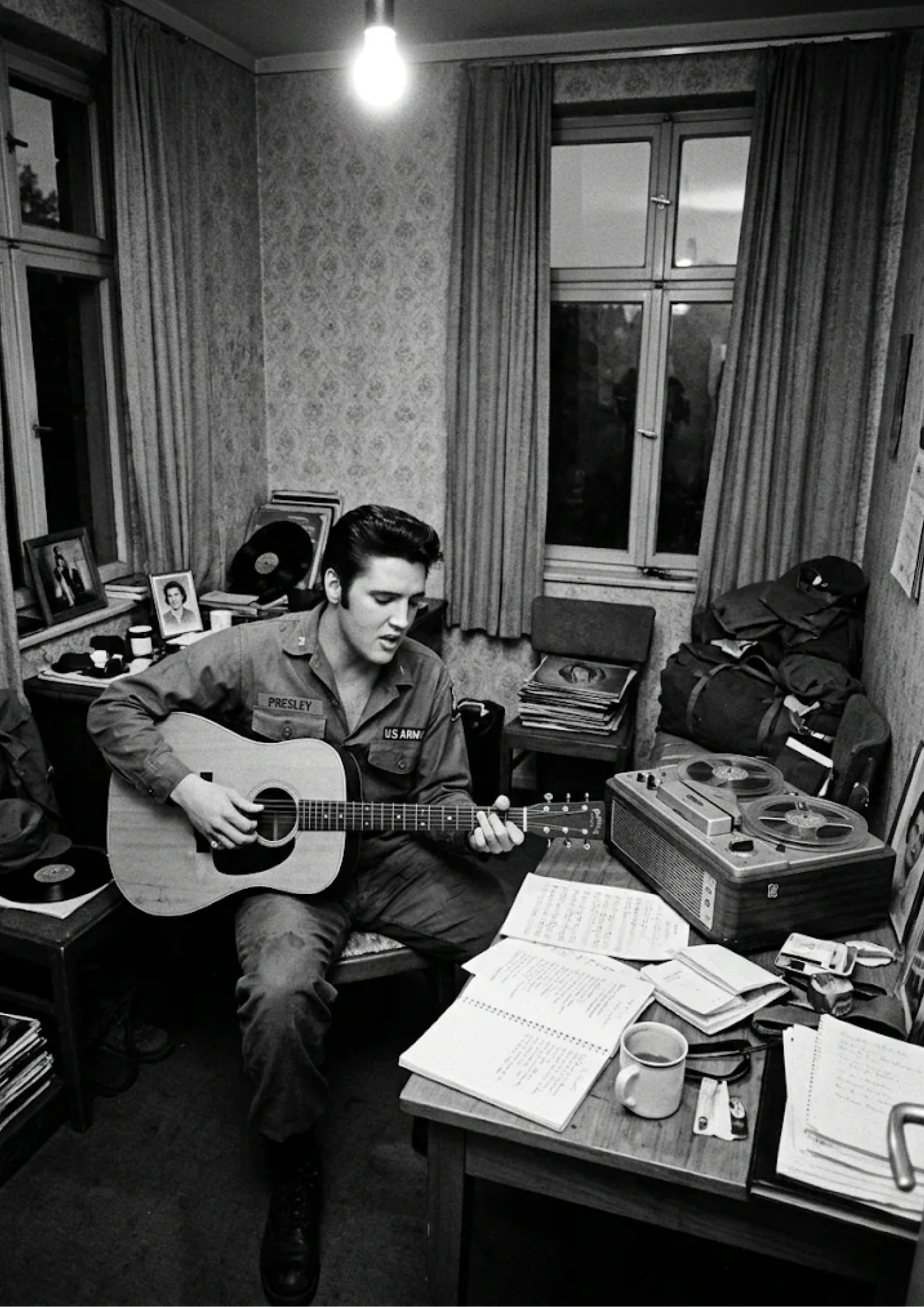
The Lost Tapes of Bad Nauheim: The SHOCKING 1959 Gospel Recordings That Unmask the Real Elvis Presley
In 1959, thousands of miles from the screaming arenas of North America, the most famous entertainer on earth was stripped of his gold lamé suits, his pompadour sheared, and his identity reduced to that of an ordinary soldier: Private First Class Elvis Presley, U.S. Army serial number 53310761. To the global press, his two-year military deployment in West Germany was framed as a geopolitical public relations triumph—a rock-and-roll rebel patriotically serving his country along the Cold War divide.
Behind closed doors in his rented off-base residence in Bad Nauheim, however, a very different drama was playing out. Unbeknownst to RCA Victor, his shrewd manager Colonel Tom Parker, or the millions of fans eagerly awaiting his return, Presley was retreating into a secret sonic world. With a consumer-grade reel-to-reel tape recorder spinning quietly in the corner, the King stripped away the polished veneer of commercial rock and poured his soul into the music that truly anchored him: raw, unadorned church gospel.
For decades, the existence of these intimate German tapes remained the stuff of whispers and collector mythology. That changed when a long-lost home reel resurfaced in 2018, meticulously remastered and released to stunned archivists in 2019 under the title Made In Germany – Private Recordings.
What the recordings revealed was nothing short of a revelation.
Free from studio deadlines, backing orchestras, and executive interference, Presley’s voice echoes with an unvarnished vulnerability rarely captured on his blockbuster singles. Selections such as “His Hand in Mine,” “Just a Closer Walk with Thee,” and “I Asked the Lord” showcase a vocalist singing not for wealth or acclaim, but for spiritual survival. In these tapes, the trademark sneer and kinetic stage persona vanish completely, replaced by intricate harmonies, improvisational phrasing, and the deep, rich baritone of a boy who grew up mesmerized by Southern tent revivals.
The timing of these private sessions adds an unmistakable layer of emotional weight. Just months earlier, in August 1958, Elvis’s mother, Gladys, had passed away suddenly at the age of forty-six—a catastrophic blow that fractured the young star’s inner world. While historians caution against reading every recording solely as an explicit monument of mourning, the solemnity permeating these German sessions captures a young man navigating exile, sudden grief, and the bewildering machinery of global fame.
It was also against this quiet German backdrop that a fourteen-year-old Priscilla Beaulieu first entered his world, beginning a relationship that would shape the rest of his life.
Presley was famously trapped between two conflicting identities: the rebellious sex symbol of American youth culture, and the deeply religious Southern son whose artistic compass never strayed far from the hymnal. When he finally returned to a civilian recording studio in 1960, his very first non-soundtrack project was not a rock LP, but His Hand in Mine—an album that went on to earn him enduring critical acclaim and establish gospel as his ultimate artistic haven.
Ultimately, the forgotten 1959 Bad Nauheim recordings dissolve the caricature of the 1950s rock icon. They prove that long after the cameras stopped flashing and the stage lights went dark, the true heartbeat of Elvis Presley was never found in the roar of the crowd—it was kept alive in the quiet, sacred songs he sang only to himself.