Introduction
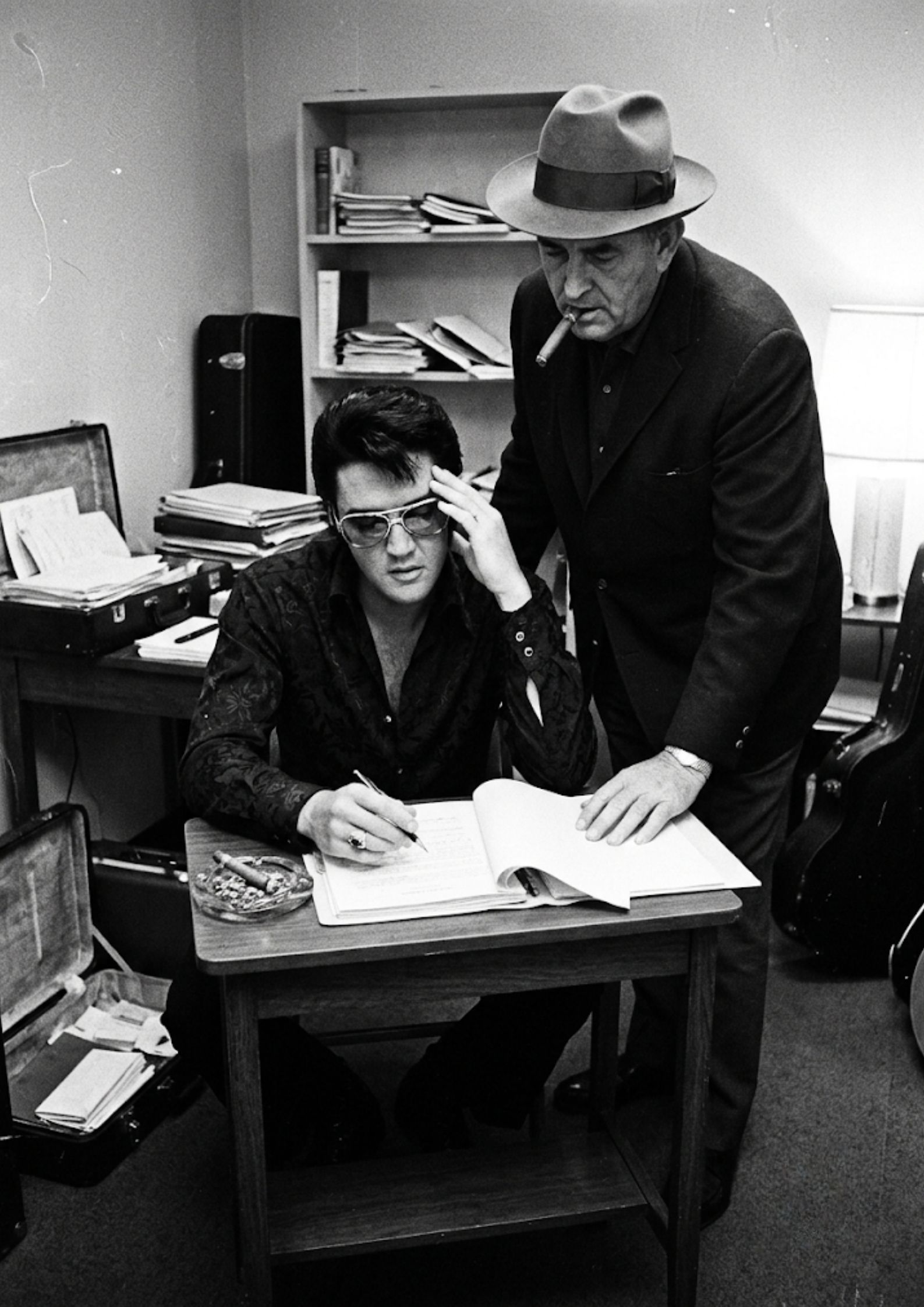
The 50 Percent Shackle: THE SHOCKING Financial Siphon, Secret Dutch Identity, and the Faustian Pact Between Elvis Presley and Colonel Tom Parker
He was the sovereign of modern music—a transcendent cultural icon who generated tens of millions of dollars in record sales, cinematic box office receipts, and historic Las Vegas residencies. He owned private jetliners, gifted fleets of Cadillacs, and ruled Graceland like an absolute monarch.
Yet beneath the diamond rings and blinding marquee lights of the Las Vegas Strip, Elvis Presley operated under one of the most punitive, asymmetric commercial contracts in entertainment history.
For decades, the standard managerial commission in American show business hovered strictly between 10 and 20 percent. Colonel Tom Parker pocketed as much as 50 percent of the gross.
How did an international deity surrender half of his life’s labor to a single man? And why did Presley—a man who could fill stadiums with a flick of his wrist—remain bound to a managerial fortress that bled his equity until the day he died?
The Dutchman Without a Passport
The architecture of control began with a secret.
The man the world knew as “Colonel Tom Parker”—the cigar-chomping, Southern carnival barker sporting an honorary title bestowed by Louisiana Governor Jimmie Davis—was neither a colonel nor an American. He was Andreas Cornelis van Kuijk, born in Breda, Netherlands, in 1909.
Arriving in the United States as an undocumented stowaway after mysteriously deserting the Dutch military, Parker spent his life terrified of federal scrutiny. Because he lacked legal citizenship and an American passport, Parker could not leave the country without risking deportation.
This hidden vulnerability secretly dictated the trajectory of Presley’s career. Despite lucrative, record-breaking offers to stage stadium tours across Europe, Japan, and the United Kingdom, Parker flatly refused international dates, concocting transparent excuses about foreign security risks. The King of Rock and Roll was deliberately kept in an American cage simply because his manager could not legally leave American soil.
The Battle for the King’s Soul: 1968
Throughout the 1960s, Parker treated Presley less as an evolving artist and more as an industrial commodity. He systematically funneled the King into thirty-one low-budget Hollywood musical comedies, cranking out formulaic studio soundtracks to maximize fast profits and capture lucrative music publishing kickbacks through Hill & Range.
By 1968, Presley was drowning in commercial irrelevance.
When NBC approached the camp for a television special, Parker aggressively campaigned for an innocuous, family-friendly Christmas program—envisioning Elvis singing carols in an embroidered holiday sweater.
Instead, visionary television director Steve Binder staged a cultural rebellion. Teaming up with Presley behind Parker’s back, Binder stripped away the Hollywood artificiality, poured Elvis into a black leather suit, and placed him in the center of an intimate, raw boxing ring format. The ’68 Comeback Special shattered network ratings and revitalized Presley’s creative fire.
Yet the victory of the spirit did not loosen the financial vise.
The $5.4 Million Catastrophe: Sacrificing the Dynasty
In 1969, Parker capitalized on Elvis’s resurgence by locking him into an exhausting, endless grind of Las Vegas residencies at the International Hotel. While Presley was showered with immediate cash, Parker was racking up monumental gambling debts at the casino tables—debts industry insiders long suspected influenced his eagerness to keep Elvis bound to grueling casino contracts.
The catastrophic climax of Parker’s management arrived on March 1, 1973.
Facing cash-flow pressures, Parker brokered a deal with RCA Records selling outright Presley’s entire pre-1973 recording catalog—over 700 master recordings, including “Heartbreak Hotel,” “Hound Dog,” “Jailhouse Rock,” and “Suspicious Minds”—for a flat lump sum of $5.4 million.
After taxes and Parker’s astronomical 50 percent cut, Elvis walked away with an estimated $1.35 million.
RCA had acquired perpetual ownership of the most culturally significant audio catalog in twentieth-century history for pennies on the dollar. Decades later, while RCA reaped billions from reissues, box sets, and streaming rights, Presley’s estate received zero artist royalties from the songs that built his legend.
The Reckoning: “Shocking to the Court”
Following Presley’s sudden death at Graceland on August 16, 1977, the true state of his finances sent shockwaves through probate court. Despite earning hundreds of millions during his life, Elvis left behind a cash-poor estate valued at just $4.9 million, facing imminent collapse under half a million dollars in annual maintenance and heavy estate tax liabilities.
Memphis Probate Judge Joseph Evans appointed independent attorney Blanchard E. Tual to investigate Parker’s management practices on behalf of nine-year-old sole heir Lisa Marie Presley.
Tual’s explosive December 1980 forensic report uncovered a sprawling web of self-dealing, conflicts of interest, and predatory fees. Tual revealed that Parker had routinely placed his own financial enrichment above his client’s fiduciary interests, collecting unprecedented commissions while Elvis carried the operating liabilities.
Judge Evans was scathing, publicly ruling that Parker’s 50 percent cut was “excessive, shocking to the court, and contrary to the industry standard.” Evans formally ordered the estate to strip Parker of his authority and file suit against him for breach of fiduciary duty.
After years of bitter litigation, the estate, RCA, and Parker settled in June 1983. Parker relinquished all future claims to the Presley estate and his master contracts in exchange for a buyout, officially severing the umbilical cord that had bound the King for nearly thirty years.
The Psychology of Captivity
Why did Elvis never fire him?
The answer lies in the complex psychology of a boy from Tupelo, Mississippi. Elvis remembered grinding poverty, evictions, and shame. Parker had been the wizard who lifted him from a Memphis delivery truck and placed him on an international pedestal. To Elvis, Parker was an indispensable father figure and an unshakeable talisman against poverty.
Parker had carefully engineered Presley’s isolation, ensuring the singer believed that without the Colonel’s brilliant marketing machinery, the entire empire would collapse overnight. Caught in a web of gratitude, manufactured fear, exhausting touring schedules, and declining physical health, Presley lacked the emotional and logistical stamina to wage war against the only manager he had ever known.
Colonel Tom Parker survived his meal ticket by two decades, dying in 1997. But the historical verdict remains indelible: he was a promotional mastermind whose genius built the throne of the King of Rock and Roll—and whose predatory greed ensured that the King spent his life performing inside a gilded cage.