Introduction
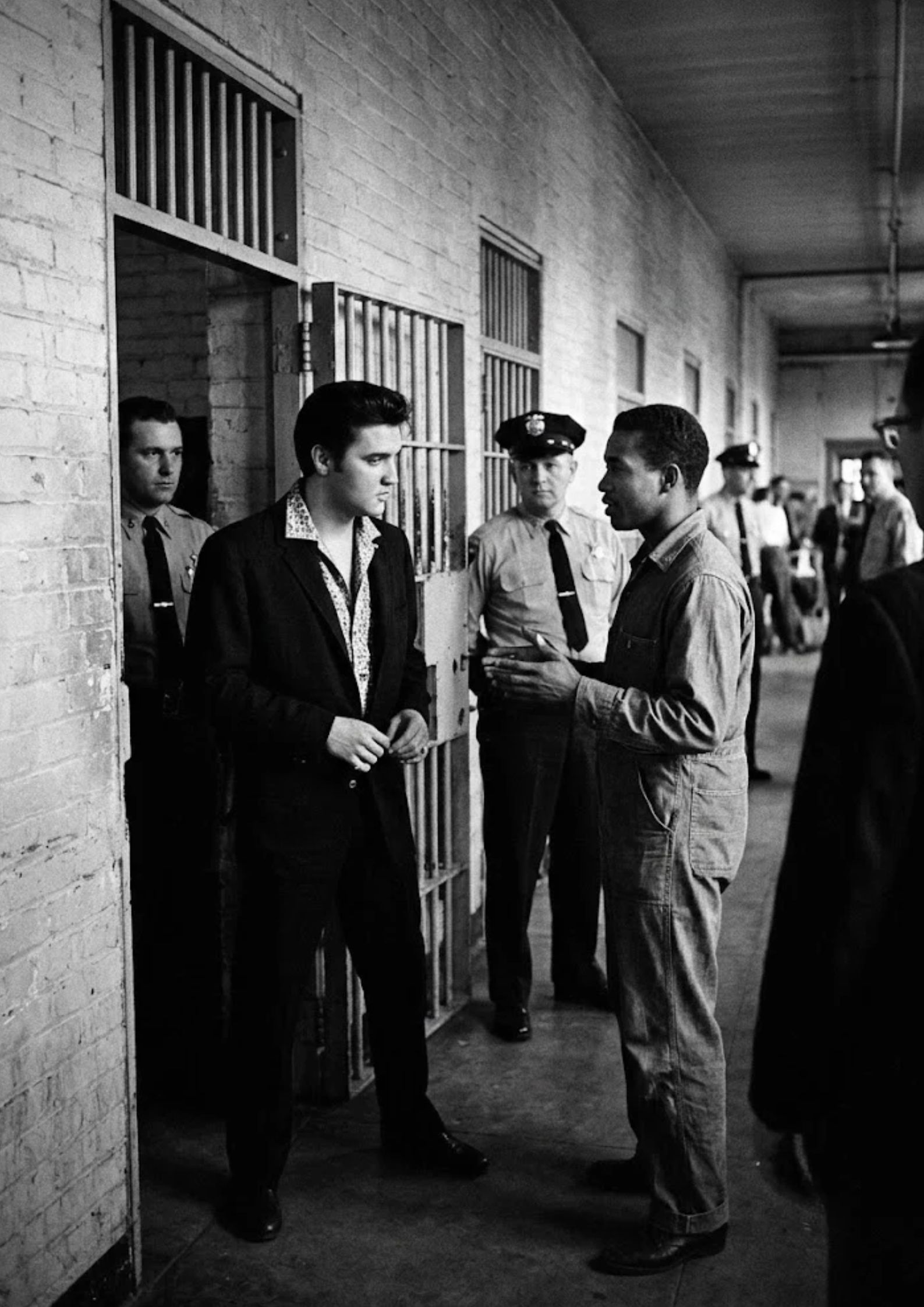
The 45-Minute Detour to Death Row: Inside Elvis Presley’s Secret 1961 Penitentiary Encounter That Baffled State Officials
On March 8, 1961, the state of Tennessee rolled out its highest civilian honors for Elvis Presley. Standing inside the State Capitol, the twenty-six-year-old superstar was formally commissioned as an honorary “Colonel Aide-de-Camp” by Governor Buford Ellington—a lavish ceremony designed to canonize rock and roll’s prodigal son into respectable Southern society. Yet, within hours of accepting the award, Presley’s motorcade abruptly veered away from the planned Memphis route. Slipping past the flashbulbs of political reporters, the King made a clandestine 45-minute stop inside the imposing limestone fortress of the Tennessee State Penitentiary.
Contemporary accounts recorded by the Nashville Banner on March 9 revealed that the unscheduled prison run was entirely Elvis’s idea. Accompanied by stunned associates, Presley was escorted through the maximum-security complex, touring industrial workshops, the inmate mess hall, and the chilling corridor adjoining the facility’s electric chair. However, the pilgrimage was far from a voyeuristic brush with infamy. Elvis had arrived to seek out a solitary inmate: Johnny Bragg, the visionary songwriter and incarcerated lead vocalist of Sun Records’ historic group, The Prisonaires.
Long before Elvis shook the foundations of American culture, Bragg had achieved an unprecedented miracle from inside prison walls. While serving a multi-decade sentence, Bragg co-wrote “Just Walkin’ in the Rain,” a rhythm-and-blues masterpiece that producer Sam Phillips recorded at Sun Studio in 1953 by escorting the inmate vocal group under armed guard. The record crossed racial and geographic lines, becoming a national sensation while its creator remained locked behind iron bars. Elvis, who spent his teenage years haunting Sun Records and studying Memphis’s underground vocal groups, knew Bragg’s work intimately—a rare fraternity of early rock innovators whose paths had fractured into starkly opposing destinies.
The brief, quiet dialogue that unfolded between the world’s most idolized performer and an incarcerated blues pioneer remains one of music history’s most guarded moments. No press were admitted into the cell block, and no recording equipment documented the exchange. Elvis never leveraged the visit for commercial publicity, nor did he issue self-aggrandizing statements to the press. Instead, the 45-minute encounter stood as a private act of reverence: the global monarch paying unvarnished respect to a forgotten Sun Records forebear who had carved out artistic immortality from the shadows of captivity.
By the time Presley exited through the prison’s heavy iron gates and resumed his journey home to Graceland, he left behind a haunting contrast that stripped the varnish from postwar celebrity. On a day engineered to celebrate the pomp and power of his fame, Elvis Presley chose instead to remind himself where the music truly came from—stepping into the darkness of death row to honor a genius the world had locked away.