Introduction
The $1.5 Million Departure: Inside the 20-Month Timeline That Severed Elvis and Priscilla’s Empire
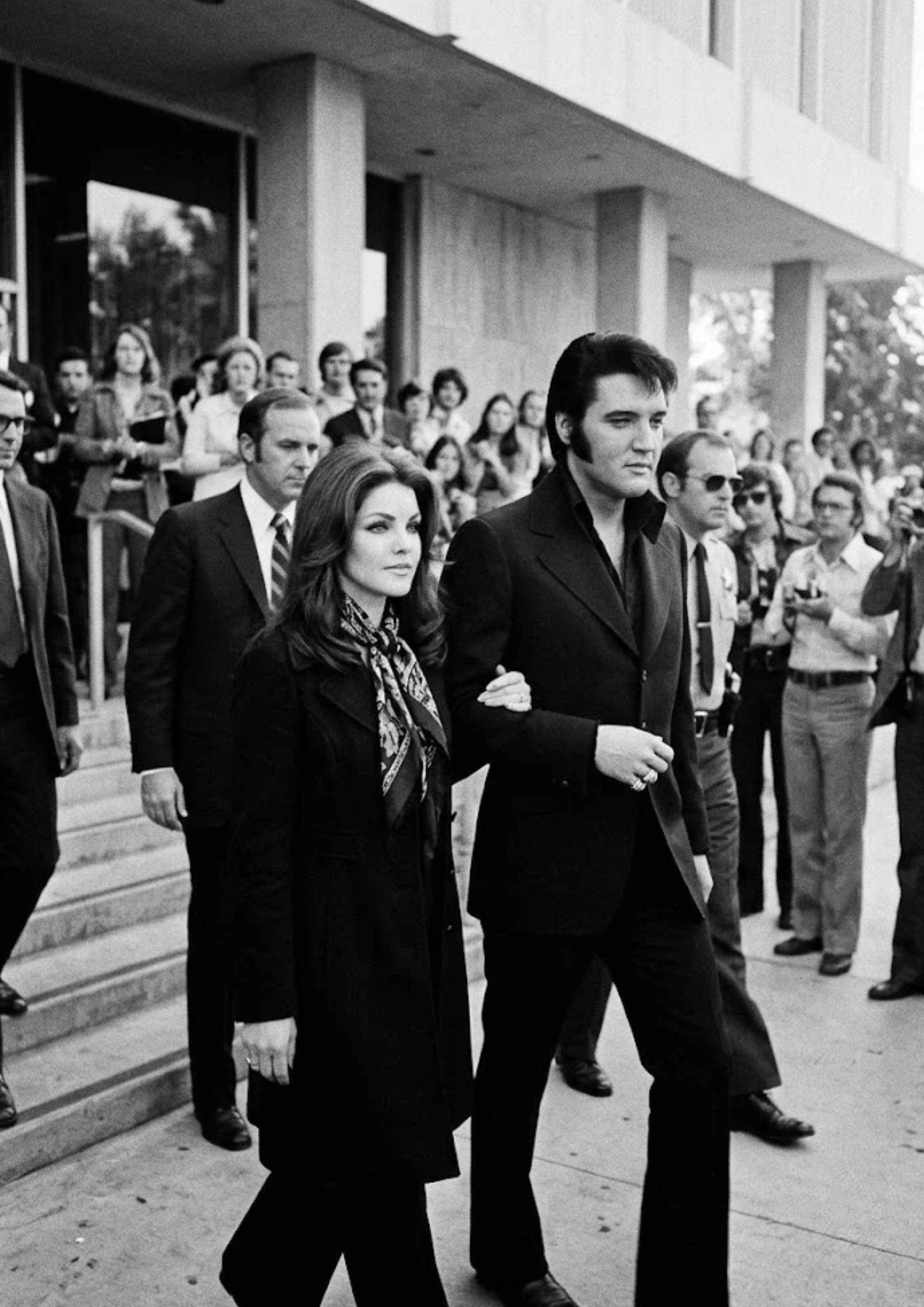
On October 9, 1973, in a Santa Monica courthouse, one of the most culturally scrutinized marriages of the 20th century officially came to a close. Yet, the scene that transpired on the courthouse steps defied the bitter, combative expectations of the era’s celebrity divorces: Elvis and Priscilla Presley emerged arm in arm, share a brief, affectionate kiss, and departed as partners in an unfinished history. Behind this remarkably civil exit lay a complex 20-month legal timeline and a landmark financial settlement that would forever reshape the Presley empire.
To understand the scale of this dissolution, one must trace the timeline from their February 1972 separation. For 19 and a half months, legal counsel for both parties meticulously navigated the vast financial and personal apparatus of the King of Rock and Roll. Contrary to later sensationalized narratives of greed and delays, the historical record reveals a highly calculated effort to dismantle a shared life while preserving a fragile family unit for their young daughter, Lisa Marie.
The compromise came in stages. A preliminary property settlement in August 1972 offered Priscilla a modest $100,000 cash payment, along with a 1971 Mercedes-Benz, a 1969 Cadillac Eldorado, and a 1971 Harley-Davidson. However, as the finality of the divorce approached, a substantially more robust October 1973 agreement was reached. This subsequent contract, valued in its entirety by The Los Angeles Times at roughly $1.5 million, yielded a $725,000 cash payment, ongoing spousal and child support, and crucially, a five percent stake in two of Elvis’s music publishing companies. This final clause went beyond mere capital, granting Priscilla a perpetual, albeit minority, interest in the cultural output that defined Elvis’s legacy.
Priscilla’s departure at age 27 was not a hostile break, but a necessary seek for independence from the suffocating, entourage-driven world of Graceland. The end of the marriage did not signify the end of their alliance. While Elvis never remarried, Priscilla used the agency her independence provided to safeguard the very legacy she had left behind. Following Elvis’s tragic passing in 1977, she would step into the vacuum as the executor of the Presley estate, ultimately making the high-stakes decision to open Graceland to the public in 1982. The timeline that began as a $1.5 million legal exit ultimately came full circle, transforming a former teenage bride into the chief architect of the Presley immortal myth.
Video: