Introduction
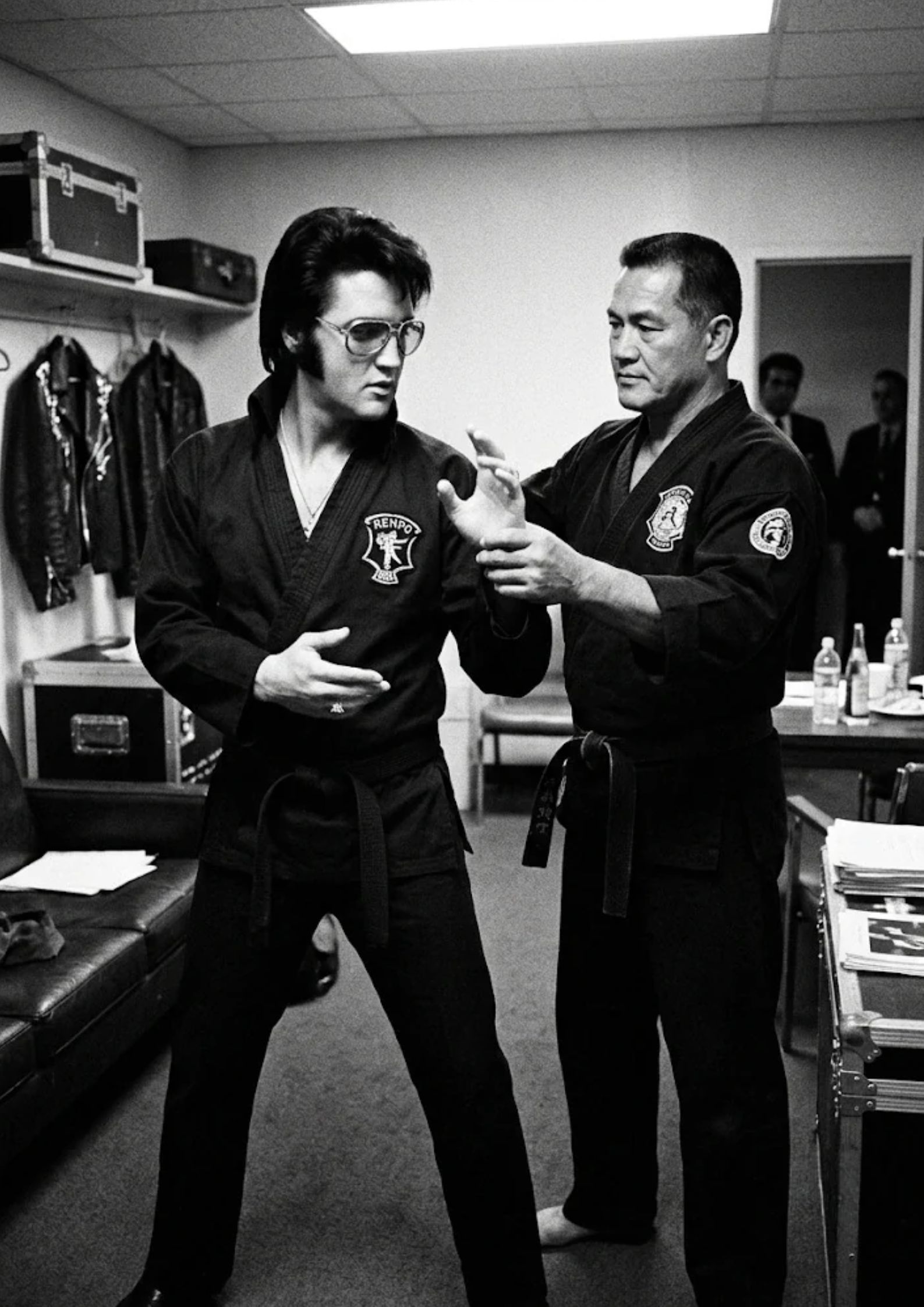
Shadows of the King: Inside Elvis Presley’s Secret 17-Year Brotherhood with Karate Grandmaster Ed Parker
Behind the explosive theatricality, the blinding flash of jumpsuits, and the impenetrable wall of fame, Elvis Presley lived in a intensely guarded, private universe. Only a select few were ever permitted to cross that threshold.
Among them was a man who had absolutely no connection to the entertainment industry when their paths first began to converge: Ed Parker, the pioneering “Father of American Kenpo Karate.”
For nearly seventeen years, Parker was much more than Presley’s martial arts instructor or a trusted bodyguard. He was a spiritual confidant, a brother-in-arms, and one of the very few people who could see the vulnerable man beneath the King’s burden of superstardom.
In his poignant, decades-old memoir Inside Elvis (1978), Parker pulled back the curtain to reveal a private friendship defined by deep spiritual quests, physical discipline, and unyielding loyalty—a side of Elvis Presley the world was never meant to see.
The Unlikely Convergence
The friendship that would transform both of their lives began in completely different worlds.
In 1954, Edmund Kealoha Parker was honorably discharged from the United States Coast Guard and returned to civilian life, enrolling at Brigham Young University in Provo, Utah. A proud Hawaiian of intense focus and drive, Parker lived by a strict personal code of discipline, self-reliance, and physical awareness—the exact foundation of what would become American Kenpo.
At the exact same moment, Elvis Presley was still a scruffy, polarizing teenager from Memphis, fighting to make a name for himself.
Parker’s martial arts reputation quickly spread. By the time he was leading high-profile demonstrations—such as a famous exhibition during a BYU-UCLA basketball game on December 2, 1955—and establishing his own Pasadena, California dojos, Elvis had become a global phenomenon.
They were traveling on vastly different trajectories, but a shared obsession was quietly pulling them together.
May 12, 1960: The Fateful Meeting
Elvis Presley’s love for martial arts had actually ignited during his military service in Germany, where he studied Shotokan and Chito-Ryu. When he returned to the United States in 1960, he sought a more rapid-fire, practical, street-effective system of self-defense.
He found exactly what he was looking for in Ed Parker.
On May 12, 1960, the two men met for the first time. The connection was instantaneous and electric. This was no fleeting celebrity acquaintance; Elvis had found a master of movement, and Parker had found a student with natural athletic brilliance and an insatiable desire to learn.
Elvis threw himself entirely into Parker’s American Kenpo system, ultimately earning his first-degree black belt under Parker’s direct supervision. He was so devoted to the discipline that he wore the Kenpo crest on his custom stage gis, famously integrated Kenpo’s lightning-fast high kicks and hand strikes into his live performance choreography, and even incorporated the martial arts “TCB” (Taking Care of Business) philosophy as his lifelong personal mantra.
A Brotherhood Away From the Screaming Crowds
But as the years wore on, Parker’s role seamlessly shifted from dojo master to a fiercely trusted protector. He was one of the very few who stood between Elvis and the ever-present threat of violence, kidnapping, or assassination that stalked his 1970s tours.
According to Parker, Elvis often faced genuine danger—including complex extortion plots and bomb threats. He relied on Parker to orchestrate decoys and execute highly sophisticated protection detail that, as Parker once proudly remarked, “some of the Secret Service could have learned a lot from.”
Yet, the true substance of their 17-year bond occurred when the adrenaline of the concerts faded and the security cordons were locked.
In the quiet, secluded backstage dressing rooms, hotel suites, and Graceland hideouts, they would talk for hours on end. Parker, whom Elvis affectionately nicknamed “Kahuna” (a Hawaiian term for a high priest or guardian), found the superstar to be a deeply spiritual, intellectually restless seeker. They ignored showbiz gossip, choosing instead to debate complex philosophies, the mysteries of mortality, ancient religions, and the intricate workings of the universe.
For Elvis, Parker was a rare anchor—a man who wanted nothing from him but his respect, and someone who refused to act as just another passive member of his entourage.
The Last Guard
Following Presley’s tragic passing on August 16, 1977, the entertainment press was flooded with highly sensationalized, often betraying exposes from former associates. Ed Parker felt a profound duty to set the record straight.
His 1978 memoir, Inside Elvis, served as a powerful defense of his fallen friend’s character. Parker sought to dismantle the caricatures, choosing instead to honor Presley’s staggering generosity, his sharp intellect, his organizational genius, and his ultimate humility.
He even offered a rare, nuanced defense of Elvis’s controversial manager, Colonel Tom Parker, choosing to separate the promoter’s business hustle from the personal tragedy that ultimately unfolded on the road.
Today, nearly fifty years since the “Kahuna” stood his final guard, the stories preserved in Inside Elvis remain essential to understanding the King’s final years. They remind us that before the tragic descent, there was an athlete, a thinker, and a deeply loyal friend who found his peace not in the spotlight, but on the mat.
In an era of endless, manufactured fame, what is the most surprising thing to you about Elvis Presley’s 17-year devotion to martial arts and his quiet search for spiritual truth? Let us know in the comments below!