Introduction
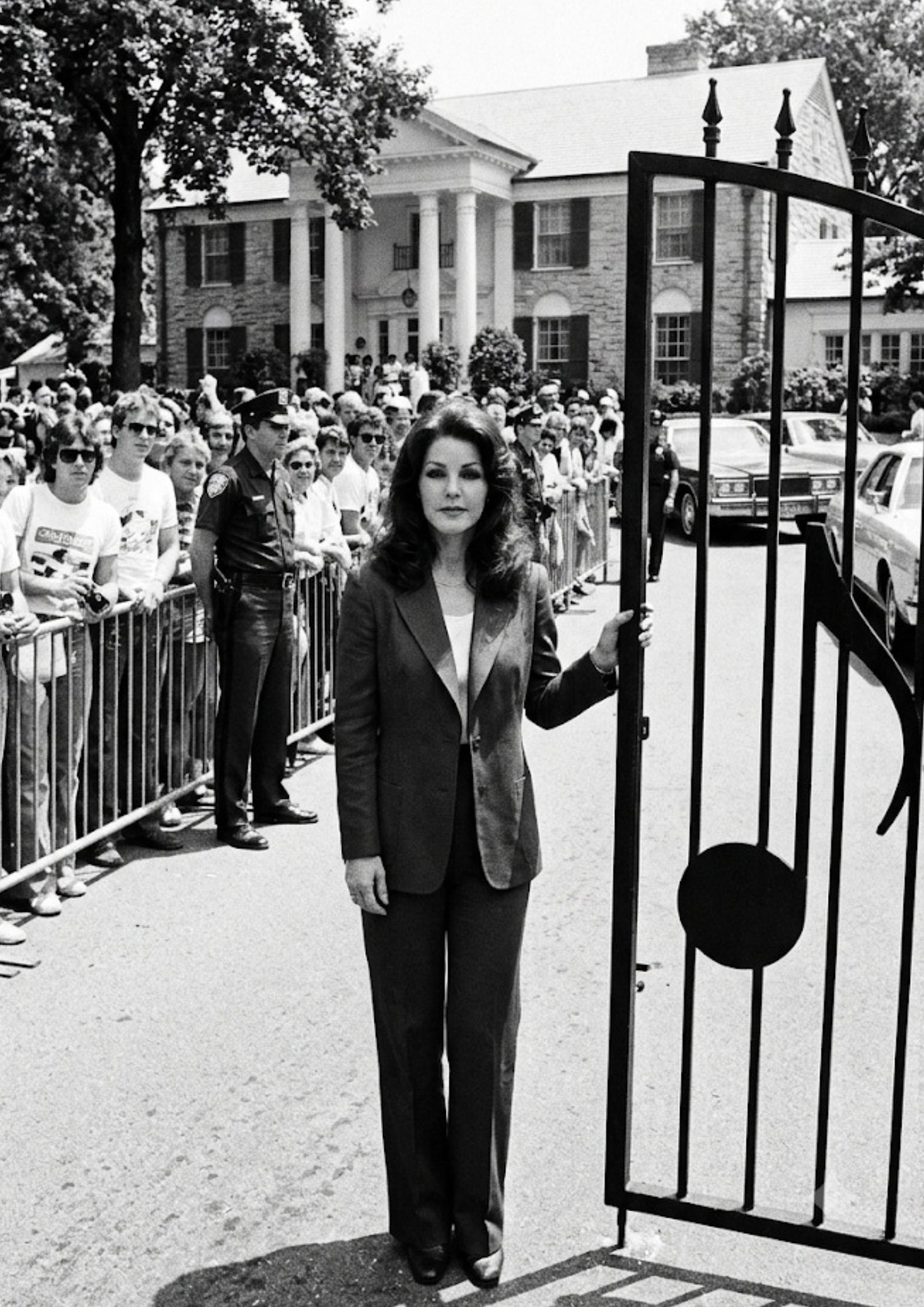
Cut From the Will: How Priscilla Presley’s High-Stakes Gamble Turned Graceland Into a $100 Million Empire
MEMPHIS, TN — For over half a century, popular mythology has reduced Priscilla Presley’s defining achievement to a single, glamorous snapshot: the fairy-tale 1967 Las Vegas wedding to the King of Rock and Roll. Millions saw the chiffon veil, the blinding flashbulbs, and the young woman elevated into entertainment royalty.
Yet music history routinely glosses over an extraordinary paradox: that legendary union had almost nothing to do with how the Presley legacy was actually saved.
When Elvis Presley signed his final will and testament on March 3, 1977—a mere five months before his sudden death at forty-two—Priscilla’s name was conspicuously absent. She was left no deed to Graceland, no authority over his recording catalog, and zero direct financial stake in his intellectual property. Elvis named his father, Vernon Presley, as executor, with his nine-year-old daughter, Lisa Marie Presley, designated as the sole residuary heir.
Priscilla, the woman globally synonymous with the Presley dynasty, was legally and financially locked out of the estate.
Yet, within five years of the King’s death, this excluded ex-wife would single-handedly rescue the family from bankruptcy, engineering a revolutionary business strategy that transformed a decaying, debt-ridden mansion into a hundred-million-dollar entertainment juggernaut.
The Impending Collapse of the Kingdom
The shockwave of Elvis’s death on August 16, 1977, unmasked a catastrophic reality: the King of Rock and Roll had died nearly broke.
Despite generating hundreds of millions in gross revenue during his lifetime, decades of erratic financial management, ruinous 50% management cuts to Colonel Tom Parker, and an infamous 1973 buyout of his back catalog had starved the estate of consistent royalties. Compounding the crisis were staggering IRS inheritance taxes and the crushing operational overhead of Graceland itself.
Costing nearly $500,000 annually in property taxes, round-the-clock security, groundskeeping, and staff salaries, the 14-acre estate was bleeding cash. By 1979, the estate’s liquid reserves were estimated to have plummeted to under $1 million—hardly enough to cover another year of bills.
When Vernon Presley passed away in June 1979, a devastating vacuum opened. Lisa Marie was a minor, unable to inherit or manage the estate until her twenty-fifth birthday. The tax authorities and bank executors saw only one viable escape route: liquidate the assets, subdivide the grounds, and sell Graceland to the highest commercial bidder.
Faced with the total erasure of her daughter’s heritage, Priscilla stepped into the breach.
The 1982 High-Stakes Gamble
Assuming the role of co-executor alongside corporate trust officers, Priscilla refused to sign the liquidation orders. Instead, she proposed an idea that many inside the Memphis circle considered reckless, vulgar, and borderline sacrilegious: open Elvis’s private sanctuary to the ticket-buying public.
Traditionalists were horrified. To open the doors of a private residence where a man had lived, loved, suffered, and died was labeled by critics as the ultimate commercial exploitation of grief.
Financially, it was an all-in gamble. The estate was forced to invest roughly $500,000 of its remaining, dwindling credit to pave parking lots, construct turnstiles, install ticket booths, and train security staff. Had the public rejected the concept, Elvis Presley Enterprises would have collapsed into immediate bankruptcy.
On June 7, 1982, the iconic musical-note iron gates swung open.
The gamble paid off overnight. Thousands of fans, who had spent years weeping outside the perimeter stone wall, formed lines stretching miles down Elvis Presley Boulevard under the blistering Tennessee sun. Within thirty-eight days, Graceland recouped its entire half-million-dollar investment.
Rewriting the Blueprint of Cultural Tourism
Priscilla’s masterstroke was not merely selling entry tickets; it was pioneering a modern blueprint for celebrity estate management.
Before Graceland, an artist’s post-mortem earning power depended almost exclusively on reissue records and live archival compilations. Priscilla and her business team flipped the paradigm, proving that physical heritage, curated mythology, and experiential pilgrimage could sustain a global brand indefinitely.
Under her direction, Elvis Presley Enterprises took aggressive, unprecedented steps:
-
Reclaiming the Trademark: They waged systematic legal battles across the globe to reclaim Elvis’s likeness, name, and image from counterfeiters and black-market souvenir rings, establishing ironclad intellectual property protections.
-
The Experience Economy: They expanded the footprint to include luxury guest accommodations, automobile museums, aircraft exhibits, and immersive dining, making Graceland the second-most visited private home in the United States, second only to the White House.
The $100 Million Vindication
By 2005, the estate that had been suffocating in debt in 1979 commanded a market valuation that stunned Wall Street. Media conglomerate CKX purchased an 85% operational stake in Elvis Presley Enterprises for approximately $100 million in cash and equity, while Lisa Marie retained 15% along with 100% personal ownership of the mansion and her father’s intimate personal effects.
Priscilla Presley was never handed an empire. When the will was unsealed, she held nothing. Yet through sheer tenacity, commercial instinct, and refusal to surrender the keys to history, she salvaged an iconic American dynasty from the auction block.
The wedding in Vegas created a famous photograph. But opening the gates of Graceland preserved the King for eternity.
Do you view the decision to commercialize and open Graceland as a masterclass in business survival, or did it cross the line into commercializing a private tragedy? Share your perspective in the comments below!