Introduction
Bullets, Betrayals, and the Gilded Shackle: The SHOCKING Hidden Escapades and Corporate Suffocation of Elvis Presley
To history, Elvis Presley remains frozen in amber: an untouchable mid-century deity whose hips shattered conservative orthodoxy and whose operatic baritone forged modern rock and roll. Yet behind the lacquered hair, private railcars, and sold-out arenas lay an insulated, paranoid, and often volatile reality—one where loaded firearms sat on nightstands, backstage trysts risked the fury of mob-connected legends, and a predatory publishing cartel quietly stripped an American original of his musical sovereignty.
The unvarnished mechanics of this private universe were documented by those inside the inner sanctum, none more intimate than Joe Esposito, Presley’s road manager, confidant, and primary gatekeeper. Through his candid memoir, Good Rockin’ Tonight: Twenty Years on the Road and on the Town with Elvis, Esposito dismantled the sanitized myth machine, exposing the hazardous, exhilarating, and tragic contradictions of life inside the King’s orbit.
The Ballistics of Fame: Midnight Gunplay on the Rails and Soundstages
Life traveling with Presley was never merely a tour; it was an armed caravan moving across a nation gripped by adoration and erratic hostility. Among the most startling episodes in Esposito’s recollections occurred aboard a private train traversing the American heartland. While the entourage slept, a live round shattered the window of Colonel Tom Parker’s private sleeping compartment, lodging inches from where the autocratic manager lay. Whether fired by an obsessive stalker, a reckless hunter, or a disgruntled local, the projectile served as a chilling reminder that Parker’s golden goose was perpetually walking a razor’s edge.
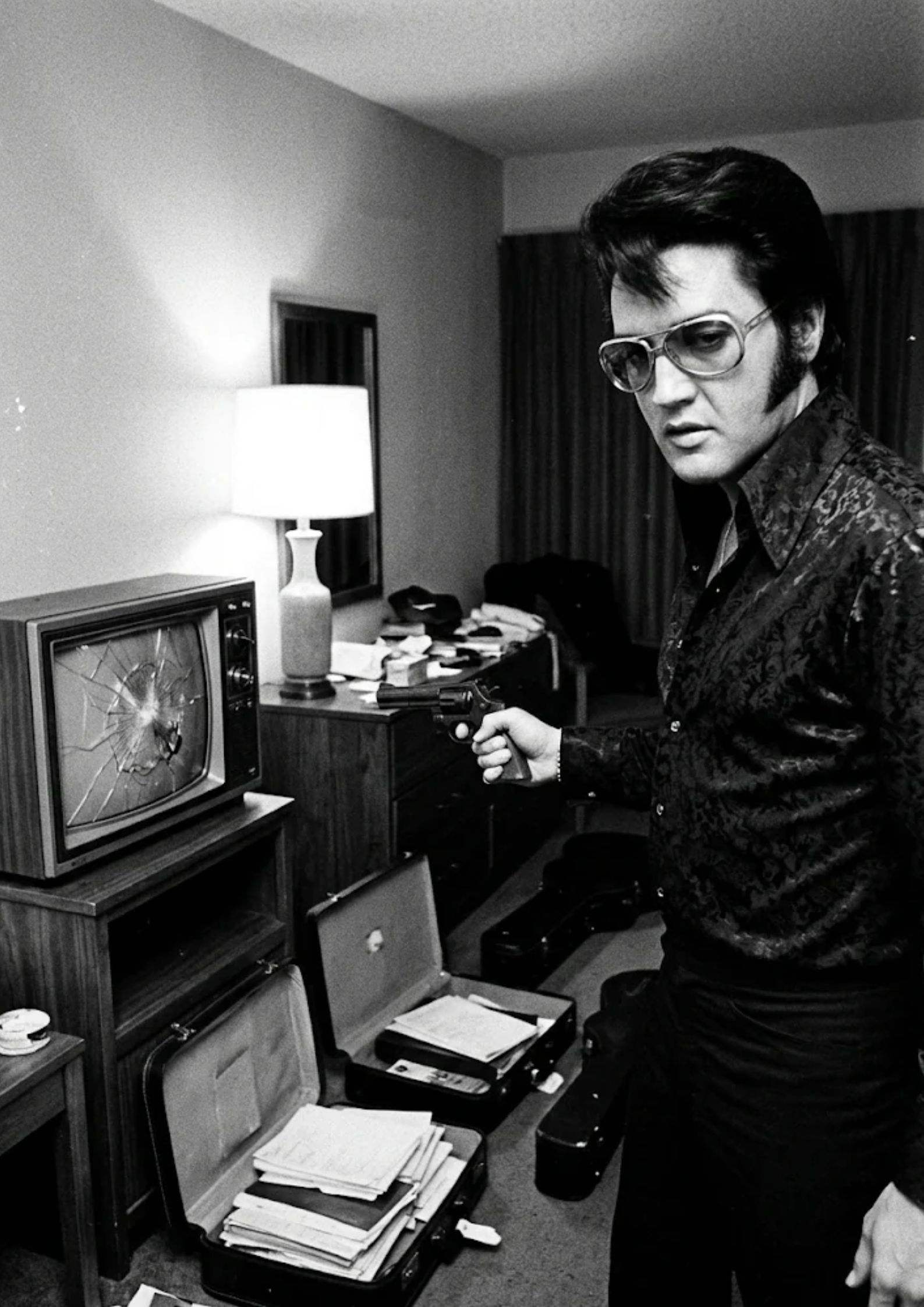
Inside the compound walls, weapons were not merely defensive shields—they became extensions of Presley’s impulsive, hyper-reactive personality. The most notorious manifestation came during an evening at Graceland, when singer Robert Goulet appeared on the television screen. Without uttering a syllable, Presley drew a handgun from his waistband and obliterated the tube with a single shot.
While pop-culture lore long reduced the incident to comic eccentricity, those close to Presley understood the deeper, darker impulse: an allergic aversion to plastic, hollow showmanship. To Presley, who treated stagecraft as a raw, gut-level spiritual communion, Goulet’s polished, mechanical delivery was an insult to the art form. The bullet was an instinctive, explosive editorial on Hollywood phoniness.
Forbidden Liaisons: The Sinatra Crossfire
Presley’s covert maneuvers were not confined to ballistics; they routinely spilled into the perilous waters of Hollywood power dynamics. During the 1960 production of G.I. Blues, fresh off his military stint in West Germany, Presley began a high-stakes, clandestine affair with co-star and South African dancer Juliet Prowse.
The affair unfolded against a backdrop of labyrinthine secrecy. Presley was concurrently romancing bit-part actress Judy Rollins, concealing each woman from the other. More dangerously, Prowse was officially engaged to none other than Frank Sinatra.
Sinatra, whose legendary temper and deep underworld connections made him Hollywood’s most feared figure, cast a long shadow over the Paramount lot. Entering Sinatra’s crosshairs carried professional and personal consequences that few men dared to test. Yet Presley operated with an insouciant defiance, drawn to the danger of a romance that existed entirely in the shadows—a pursuit of genuine intimacy in an industry where every relationship was commodified.
Broken Hands and Bruised Pride
Presley’s obsession with physical discipline led him to martial arts, studying karate under masters like Ed Parker and Kang Rhee. Yet the line between disciplined discipline and reckless bravado frequently blurred.
During an intense backstage exhibition, Presley attempted to shatter a thick wooden board with a bare-handed strike. The initial strike failed, leaving the wood intact. Refusing to yield before his entourage, Presley reset his stance and unleashed a second, violent blow, successfully splintering the board.
Moments later, tucked away in the privacy of his dressing room, the bravado evaporated. Clutching a throbbing, swollen hand, Presley grimaced to Esposito, fearing his fingers were fractured. The moment illuminated the agonizing pressure under which the King operated: the constant, exhausting compulsion to appear invincible before an adoring court, even at the cost of his own physical wellbeing.
The Corporate Cage: How Gladys Music Castrated the King
Yet the darkest betrayal Presley suffered did not come from jealous rivals or rogue bullets; it was orchestrated by his own corporate management.
Through publishing vehicles Gladys Music and Elvis Presley Music—meticulously controlled by Colonel Parker and the Aberbach brothers of Hill & Range—a ruthless mandate was enforced: Presley was barred from recording any song unless the songwriters agreed to surrender up to 50 percent of their publishing rights to Parker and his corporate shell.
This financial squeeze had an artistic cost that crippled Presley’s prime. Groundbreaking rhythm-and-blues composers, visionary Nashville storytellers, and emerging rock icons flatly refused to give away their intellectual property. As a result, Presley was starved of elite, contemporary material, systematically funneled toward generic, substandard novelty tracks owned directly by Parker’s publishing house.
The man who possessed the most transformative voice in modern history had become an artistic hostage to his own corporate apparatus, forced to croon formulaic studio fodder while the musical revolution he ignited marched forward without him.
Behind the gilded facade of royalty, Elvis Presley lived as both sovereign and prisoner. He survived bullets slicing through glass, navigated dangerous romantic triangles, and broke bone against wood to project absolute strength—all while fighting a silent, desperate war against the corporate suits who turned his genius into a balance sheet. The tragedy of the King was not that he burned out, but that the world loved the legend so fiercely, it never allowed the man to breathe.