Introduction
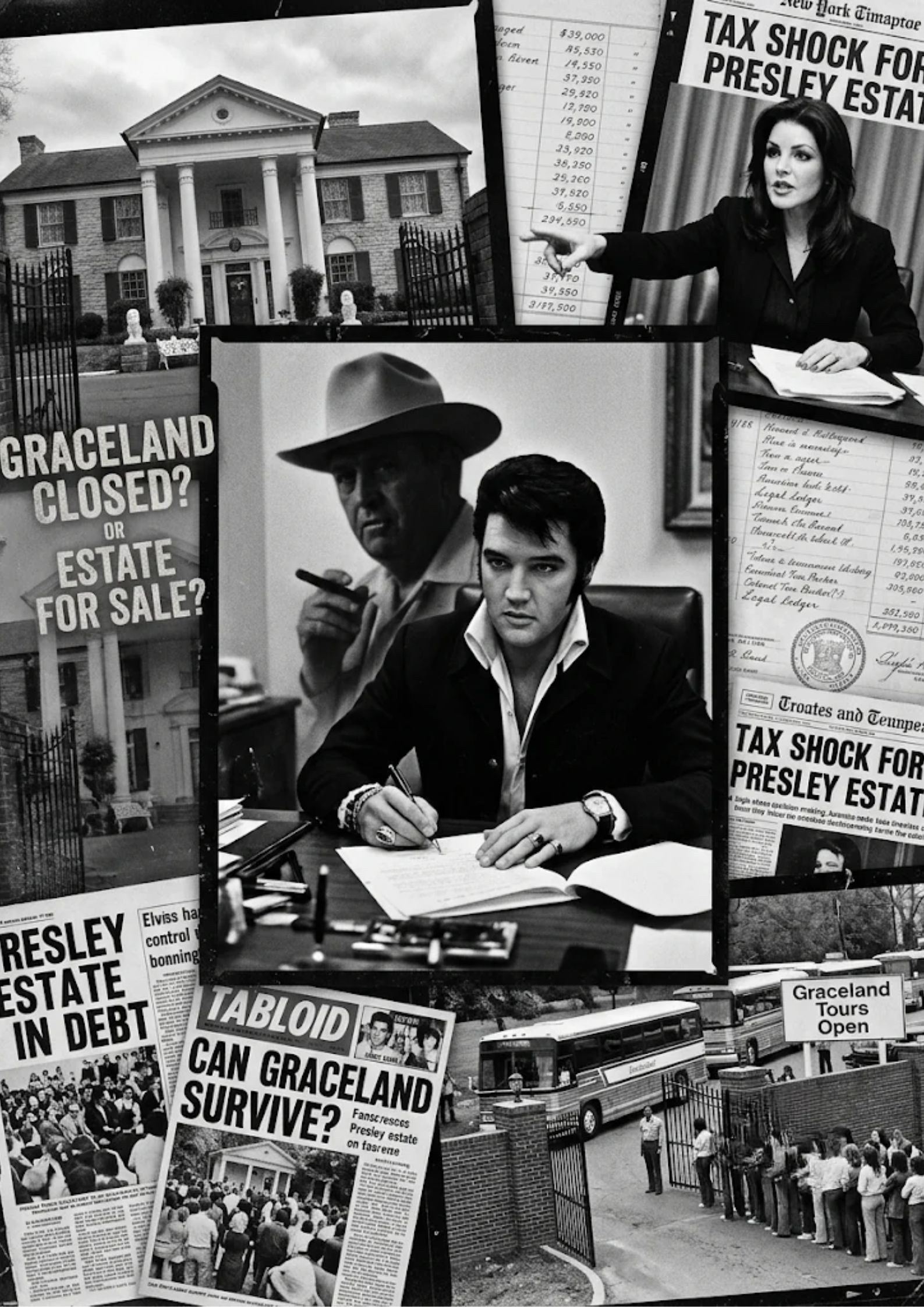
The Gilded Trap: The SHOCKING Financial Ruin That Nearly Cost the Presley Family Graceland
When Elvis Presley was pronounced dead on August 16, 1977, the public assumed his nine-year-old sole heir, Lisa Marie, was stepping into an unassailable financial empire. The King had shifted hundreds of millions of records, commanded record-breaking concert guarantees, and occupied one of the most recognizable residential estates on earth.
Yet, within months of his passing, the executor of the estate was confronted with a staggering, private reality: the empire was effectively insolvent. Behind the white Corinthian columns of Graceland lay a cash-poor operation hemorrhaging roughly $480,000 annually in basic overhead, insurance, and payroll. When the music stopped, the revenue dried up overnight—and the mansion Elvis bought to shield his family from hardship became the very engine driving them toward ruin.
The seeds of the catastrophe had been planted years earlier through disastrous management maneuvers orchestrated by Colonel Tom Parker. While standard industry managers commanded 15 to 20 percent commissions, Parker had secured an unprecedented 50 percent cut of Elvis’s major performance and recording earnings.
The most ruinous blow landed in March 1973. In desperate need of immediate liquidity, Presley signed a catastrophic deal with RCA Records, surrendering all future master-recording royalties on his entire pre-1973 catalog—over 700 classic masters, from “Heartbreak Hotel” to “Suspicious Minds”—for a lump-sum buyout of $5.4 million. After Parker extracted his 50 percent share and the IRS claimed its portion, Elvis walked away with an estimated $1.35 million. While RCA continued to generate staggering global profits off his historic recordings after 1977, the estate received virtually nothing from the catalog that built his name.
When Vernon Presley passed away in 1979, the burden of executive stewardship fell onto Elvis’s ex-wife, Priscilla Presley, alongside accountant Joseph Hanks and the National Bank of Commerce. Their inheritance was immediately met with a fiscal guillotine: in 1981, federal authorities reassessed the estate’s market valuation at approximately $22.5 million, triggering a crushing estate tax levy of roughly $10 million. With nearly zero liquid capital, high-priced attorneys urged Priscilla to liquidate Graceland to satisfy the IRS and clear mounting debts.
Instead, Priscilla launched a relentless legal and commercial counteroffensive. Representing Lisa Marie’s interests, court-appointed attorney Blanchard E. Tual published a blistering investigative report exposing Parker’s exploitative commissions and breaches of fiduciary duty. The ensuing legal showdown culminated in an out-of-court settlement in June 1983: RCA paid the estate $1.1 million, and Parker was permanently severed from the Presley operation, handing back control of the King’s name, image, and promotional destiny.
Yet the core emergency remained: how to keep Graceland afloat. Rejecting the sale of the home, Priscilla made an audacious, high-stakes gamble. Putting up approximately $560,000 of the estate’s last remaining reserves, she oversaw the conversion of the private residence into a public museum.
On June 7, 1982, the front gates of Graceland swung open to the general public.
The gamble didn’t merely succeed—it shattered every projection in the museum industry. The estate recovered its entire $560,000 capital outlay in just 38 days. By turning private sanctuary into a commercial landmark and rigorously enforcing intellectual property rights under Elvis Presley Enterprises, the team pulled the estate back from the edge of foreclosure.
By 1989, an extensive investigation by the Los Angeles Times revealed that the once-bankrupt estate had swollen past $75 million in valuation, generating more than $15 million in annual revenue.
The boy from Tupelo had spent a lifetime lavishing Cadillacs, jewelry, and estates on everyone around him, running a financial race he could only sustain by touring endlessly until his body gave out. But in the end, it was not his corporate advisors or his legendary manager who preserved his legacy. It was Priscilla Presley’s refusal to surrender the front door, turning the King’s heaviest liability into the bedrock of modern entertainment history.