Introduction
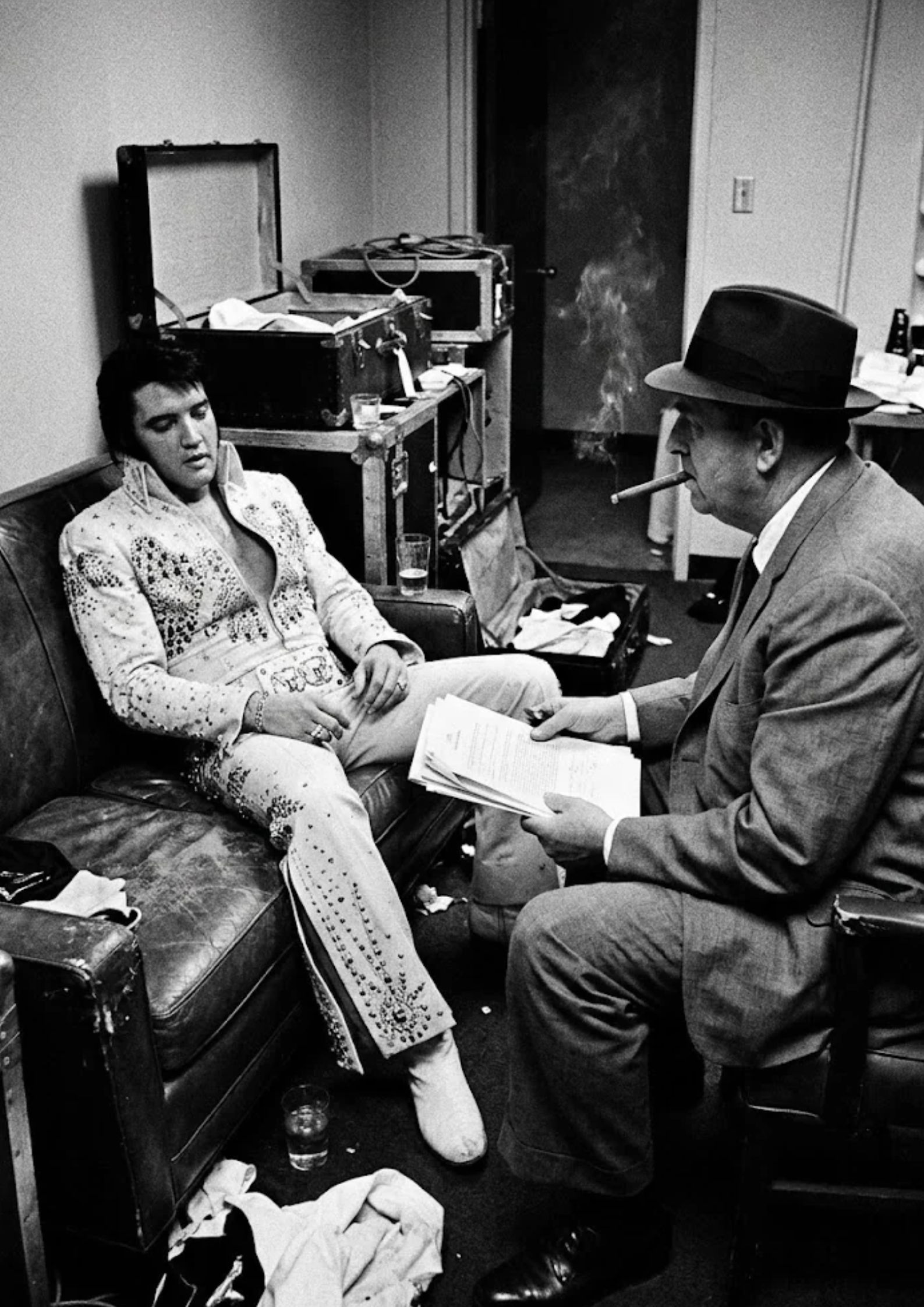
The 50-Percent Trap: The SHOCKING Truth Behind Colonel Parker’s Financial Stranglehold on Elvis
To millions of fans across the globe, Elvis Presley was the undisputed monarch of entertainment—a cultural juggernaut who traveled in private jets, purchased fleets of Cadillacs on a whim, and commanded the adoration of generations. Yet behind the dazzling gates of Graceland lay an unsettling corporate paradox: the most lucrative performer in human history was operating under an extortionate financial arrangement that quietly drained his empire. At the center of this gilded cage stood Colonel Tom Parker, an enigmatic Dutch immigrant whose iron grip on Elvis’s career came with an unprecedented price tag: an astonishing 50 percent cut of the King’s life work.
In an entertainment industry where artist managers traditionally collected between 10 and 20 percent, Parker’s split was virtually unheard of. Born Andreas Cornelis van Kuijk in the Netherlands, the self-styled “Colonel” had arrived in the United States undocumented, reinventing himself as a hard-nosed carnival promoter before identifying Presley’s explosive potential in 1955. Parker undeniably orchestrated Elvis’s meteoric rise—negotiating revolutionary television appearances, landmark RCA recording contracts, and lucrative Hollywood deals. But as the decades wore on, the line between managerial guidance and calculated exploitation blurred irrevocably.
The Faustian nature of their pact became painfully visible in the late 1960s and early 1970s. When Elvis yearned for creative liberation and live artistic reinvention during the 1968 NBC Comeback Special, Parker pushed for a hollow, family-friendly Christmas broadcast. When Elvis triumphed in black leather, Parker capitalized by anchoring the King to an exhausting, unending grind of Las Vegas residencies. Deprived of the international tours he desperately craved—largely because Parker’s lack of a U.S. passport prevented him from traveling abroad—Presley was treated as an unceasing revenue engine, forced onto the road to maintain cash flow while his health deteriorated.
The most catastrophic financial blow occurred on March 1, 1973. In a transaction that stunned later legal investigators, Parker orchestrated a deal selling Elvis’s entire pre-1973 back catalog of master recordings directly to RCA for a lump sum of approximately $5.4 million. While the payout provided immediate cash, it effectively surrendered perpetual royalties on the most iconic catalog in modern music—tracks including “Heartbreak Hotel,” “Hound Dog,” and “Jailhouse Rock.” Parker walked away with his standard half, leaving the singer divorced from the very royalties meant to safeguard his estate for decades.
The true scale of the financial damage only surfaced following Presley’s death on August 16, 1977. Appointed by the courts to protect the financial future of nine-year-old Lisa Marie Presley, Memphis attorney Blanchard E. Tual launched an exhaustive forensic audit into Parker’s business affairs. Tual’s explosive 1980 report sent shockwaves through the legal world: he formally characterized Parker’s 50-percent cut as abusive, unethical, and destructive to the Presley estate.
By August 1981, Memphis Probate Judge Joseph Evans went further, branding the Colonel’s compensation as “excessive and shocking to the court” and officially ordering the estate to sue Parker for breach of fiduciary duty. Parker vigorously defended himself, arguing that he was never an ordinary manager, but a full co-partner whose personal acumen had built the Elvis phenomenon from scratch. The bitter legal warfare raged until June 1983, when an out-of-court settlement permanently severed Parker’s financial ties to the empire, expelling him from Graceland’s future revenues.
The haunting question that remains is not simply how Parker took half, but why Elvis let him. Was it a profound, misplaced loyalty to the man who first believed in him? Was it a paralyzed fear of navigating the entertainment industry alone? Or had the King simply grown too isolated and worn down to confront the man who had controlled his life since he was twenty years old?
Elvis Presley held the power to captivate stadiums and define American music, yet inside the boardrooms, he remained captive to a deal that treated his genius like carnival merchandise. The tragedy of Elvis Presley is not merely how he lived or died—it is the chilling realization that behind the greatest spectacle in rock and roll, the King spent his life building a golden kingdom while handing half of the keys to the gatekeeper.