Introduction
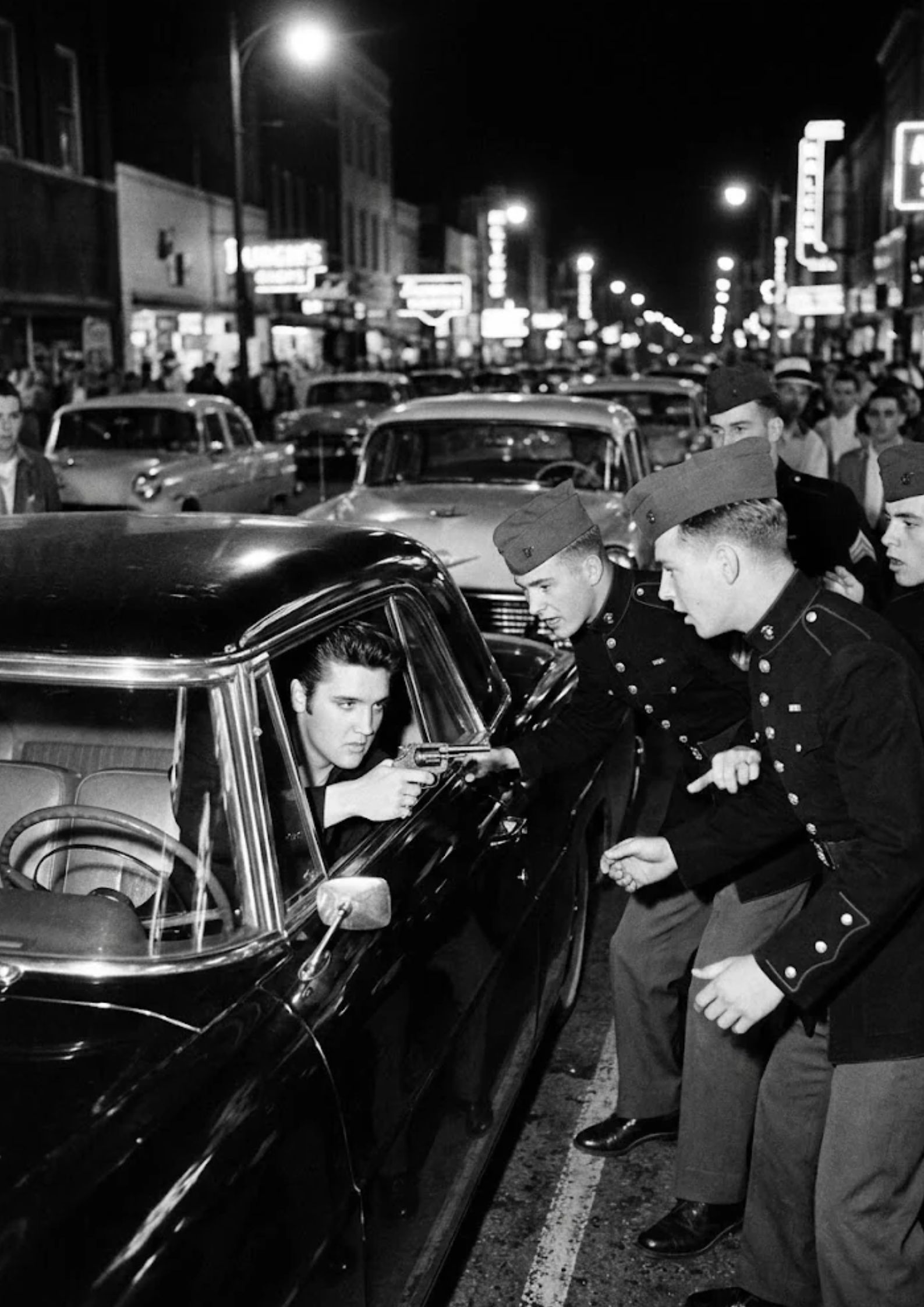
Point-Blank Panic: The SHOCKING Night Elvis Presley Pulled a Gun on a Marine
On the night of March 23, 1957, downtown Memphis became ground zero for a near-fatal misunderstanding that almost incinerated the career of music’s fastest-rising icon. Elvis Presley—just 22 years old, riding high on chart-topping hits and Hollywood contracts—sat behind the wheel of his luxury Lincoln Mark II while cruising Main Street. What began as a routine evening of youthful socializing suddenly devolved into an armed standoff with a group of active-duty U.S. Marines, culminating in national headlines alleging that the King of Rock and Roll had threatened to murder an American serviceman at gunpoint.
The explosive incident exposed not only the volatile friction between 1950s youth culture and the military establishment, but also the suffocating paranoia that trailed Elvis everywhere he went.
The trouble started when Elvis and his close confidant, disc jockey George Klein, took part in the local Memphis tradition of “dragging Main.” Spotting carloads of enthusiastic female admirers, Elvis instructed Klein to invite them to a private party at his Audubon Drive home, specifying that no boyfriends were allowed. But when Klein returned, the mood had soured instantly. A group of young men in uniform had surrounded Presley’s car.
Leading the group was 18-year-old Marine Private First Class Hershel Nixon. Confronting the singer, Nixon aggressively accused Elvis of having an illicit affair with his wife following an alleged earlier encounter. As the Marines crowded closer to test the mettle of the nation’s newest idol, the atmosphere turned menacing. Sensing an imminent brawl, Elvis reached inside his coat, pulled out a pistol, leveled it directly at Nixon, and barked an ultimatum that sent the servicemen scrambling backward.
Within hours, the local press had caught wind of the clash, and a sensational claim hit the wire: Elvis Presley had drawn a firearm on an American soldier. Yet beneath the hysterical headlines lay a bizarre reality: the gun was completely fake.
The weapon was a non-lethal studio prop Presley had brought home from a Hollywood movie lot, intending to use it for harmless pranks. While Elvis may have viewed the object as a novelty, to Nixon and his fellow Marines facing the barrel in the dark, the threat appeared lethal.
The aftermath threatened irreparable damage to Presley’s public image. Just five months earlier, in October 1956, Elvis had made national news after a fistfight at a downtown Memphis gas station. For conservative critics and church groups already demanding that rock and roll be banned for corrupting the youth, the gun incident provided prime ammunition to brand Presley as an armed delinquent and a menace to public safety.
Behind the scenes, however, a stunned and vulnerable Elvis scrambled to de-escalate the crisis. Instead of hiding behind lawyers, he dispatched an extraordinary six-page telegram directly to Private Nixon. In the message, Elvis laid bare the terrifying reality of his newfound celebrity: strangers routinely approached him under the guise of asking for autographs, only to turn suddenly hostile or violent to prove their own toughness. Presley admitted that both men owed each other an apology and insisted he never looked for violence, pleading that he only wanted to live like an ordinary citizen without constantly fearing attack.
The dispute reached its formal conclusion on March 26, 1957, inside the chambers of City Judge Beverly Roche at the Memphis Police Station. After evaluating the facts—and confirming the “pistol” was an inert movie prop—the judge dismissed all potential charges. Emerging into a barrage of flashbulbs, Presley and Nixon shook hands, mutually acknowledging that the entire episode was an unfortunate misunderstanding blown out of proportion by rumor. In a final twist of 1950s celebrity culture, Nixon apologized privately and even asked for backstage passes to Presley’s upcoming tour stop in St. Louis—an invitation Elvis granted on the spot.
The 1957 Marine standoff remains a clarifying snapshot of Elvis on the knife-edge of superstardom. Long before Graceland became a fortified sanctuary, Presley was an insecure twenty-two-year-old trapped between ordinary street life and unprecedented mass hysteria. In that tense midnight confrontation on Main Street, a harmless Hollywood prop exposed the dark, isolating reality of an idol learning that once the world turns you into a target, even your jokes can turn into public scandals.