Introduction
The Altered Choir: The SHOCKING Untold Story Behind the Voice That Created the King
Before the glittering gold lamé suits, the screaming arenas, and the irreversible transformation of global popular culture, Elvis Presley was simply an impoverished boy running through the dusty streets of Tupelo, Mississippi. For decades, music historians treated his vocal delivery as an almost extraterrestrial phenomenon—a voice that seemingly arrived fully formed from nowhere to fuse gospel, country, and rhythm and blues. Yet, tucked away in the memories of his closest confidants and early church records lies a far more intimate, startling truth.
The roots of the King of Rock and Roll’s revolutionary style were not born in a recording studio, but inside the emotionally fraught, musically saturated walls of a desperate family surviving on the margins.
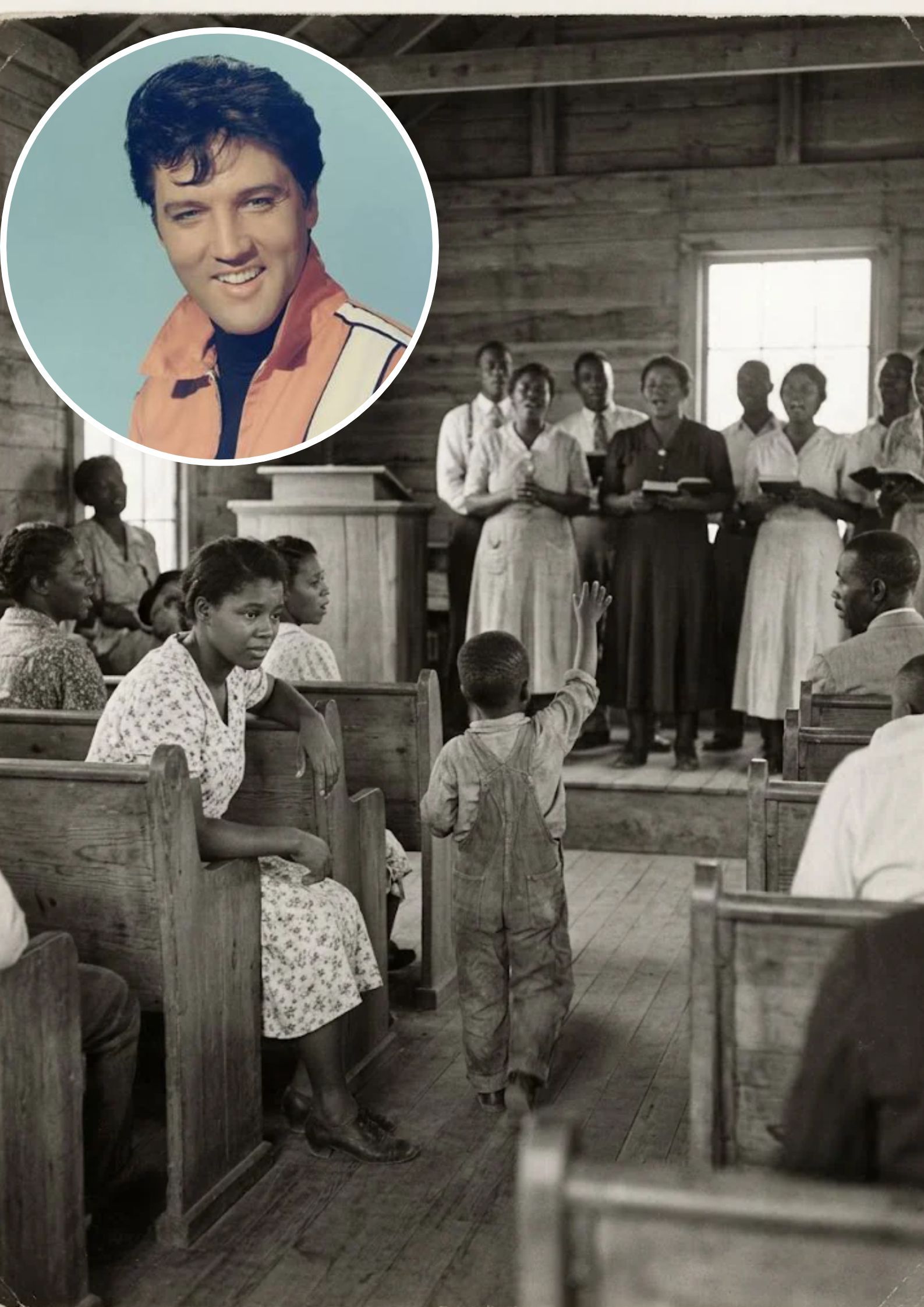
According to longtime friend and Memphis Mafia insider Red West in Elvis: What Happened?, the first documented sign of Elvis’s musical obsession occurred when he was barely three years old. During a Sunday service at the First Assembly of God Church in Tupelo, the young boy slipped away from his mother’s lap, scrambled directly toward the choir platform, and attempted to match the harmonies of the adult singers. While it is impossible to reduce a generational genius to a single childhood anecdote, the incident highlights a vital reality: Elvis’s connection to music was primal, spiritual, and present long before he ever picked up a guitar.
More provocatively, early accounts challenge the long-held myth that Elvis was the only musical talent in the Presley lineage. West and contemporary family accounts noted that Elvis’s father, Vernon Presley, possessed a strikingly pure, moving tenor voice. Neighbors and churchgoers often recounted Vernon singing gospel classics such as Where No One Stands Alone with an emotional weight that stopped entire rooms in their tracks. By age nine, Elvis was harmonizing three-part gospel with his parents in their parlor, absorbing the subtle nuances of phrasing and vocal restraint directly from his father’s underappreciated gift.
Yet, if Vernon provided the melodic blueprint, it was his mother, Gladys Presley, who forged the emotional intensity that defined Elvis’s career. Born during the depths of the Great Depression, the family lived in crushing poverty, exacerbated when Vernon was imprisoned in 1938 over an altered eight-dollar check. With Vernon confined to the Mississippi State Penitentiary at Parchman, three-year-old Elvis and Gladys clung to each other in near-total isolation. Gladys shielded her son with ferocious devotion, walking him to school every day and anchoring his moral and emotional worldview inside the Pentecostal church.
When Gladys died prematurely on August 14, 1958, at age 46, twenty-three-year-old Elvis—then already an international phenomenon stationed in the Army—suffered a psychological shatter from which many biographers argue he never fully recovered. The raw, melancholic ache that permeated his subsequent balladry was not an affectation; it was the unfiltered sound of grief for the woman who had nurtured his earliest melodies.
The legend of Elvis Presley often isolates the man from the world that made him. But stripped of commercial myth-making, the King of Rock and Roll did not invent his sound in a cultural vacuum. He was the product of a small church choir, a father’s overlooked tenor, and the indomitable devotion of a mother whose love echoed in every note he ever sang.