Introduction
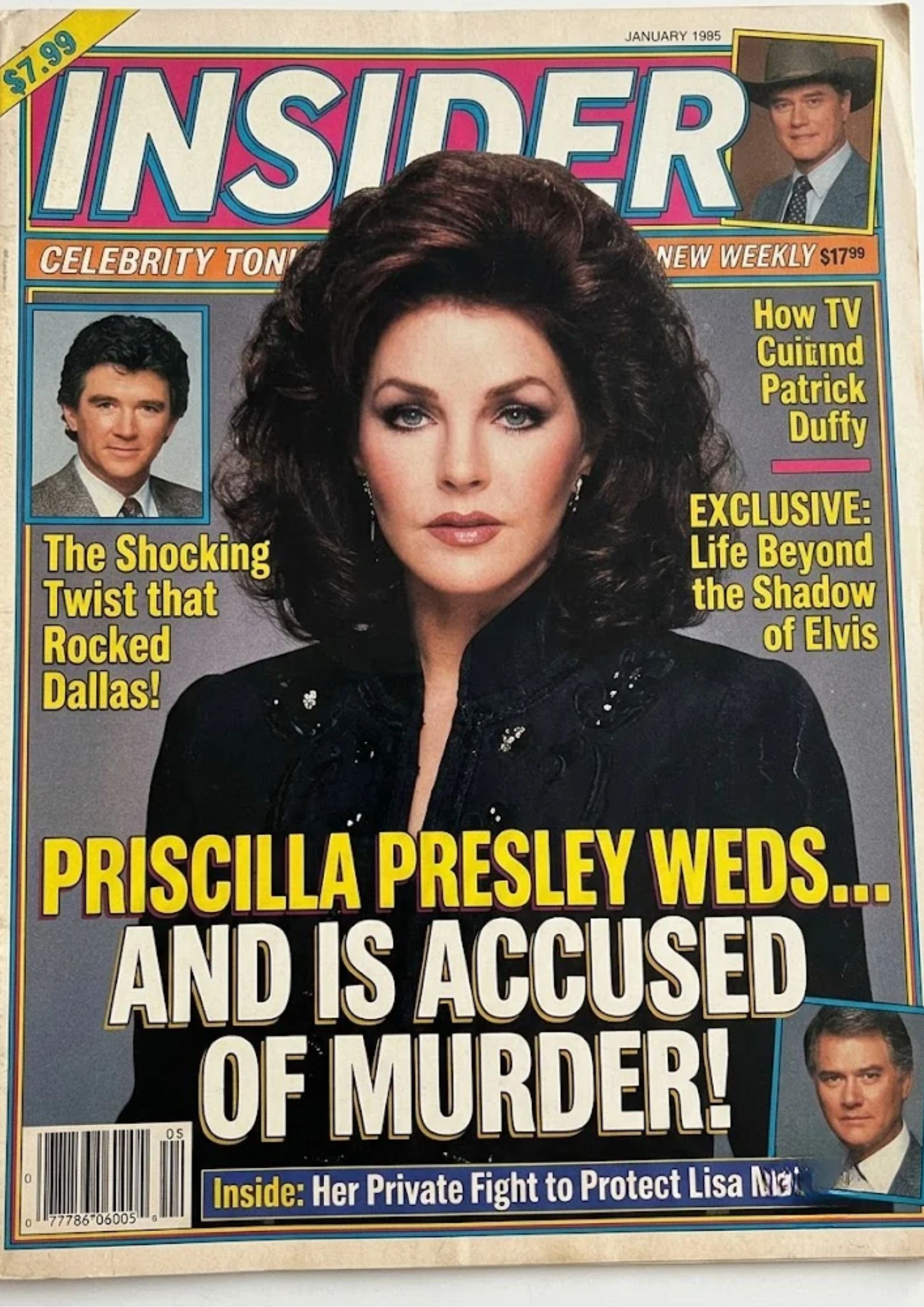
SHOCKING: Priscilla Presley Accused of Murder — The Sickening 1985 Hoax That Weaponized Elvis’s Ghost!
In January 1985, supermarket checkout lines across America were jolted by an alarming, bold-lettered tabloid banner: “Priscilla Presley weds and is accused of murder!” To a casual observer, the shocking proclamation appeared to signal the unthinkable downfall of rock-and-roll royalty. The reality, however, was a calculated sleight of hand engineered by tabloid print culture, deliberately blurring real-world domesticity with the primetime melodrama of CBS’s juggernaut soap opera, Dallas. Cast as Jenna Wade alongside Patrick Duffy, Priscilla’s scripted plot twist had been repackaged to capitalize on the public’s unyielding obsession with the Presley name. Yet beneath this sensationalist marketing lay a far more profound turning point: 1985 was the year Priscilla finally stepped out from the colossal shadow of the King to claim her own identity.
Eight years after Elvis Presley’s untimely death inside Graceland, the cultural appetite for his universe had only intensified. For years perceived merely as the porcelain teenage bride swept into an insular Memphis empire, Priscilla entered the mid-1980s actively dismantling the myth. The year marked the crucial buildup toward her landmark memoir, Elvis and Me, a publication that would forever alter public understanding of their relationship by offering an unvarnished window into life behind the iron gates. Her burgeoning career as an actress and businesswoman was not simply an ambition—it was a declaration of independence from a monolithic legacy that threatened to reduce her to a tragic footnote.
Nowhere was the friction of this legacy felt more acutely than in the upbringing of Lisa Marie Presley. As a mother navigating relentless media attention, Priscilla faced the impossible challenge of raising an heir to the greatest cultural phenomenon of the twentieth century. Protecting a teenage daughter whose private life was routinely commodified required vigilance against the very tabloid culture that had weaponized fictional scripts into defamatory headlines. Graceland had already been rescued from financial insolvency and opened to the public as a pilgrimage site, transforming a family sanctuary into a corporate empire. Yet balancing that public monument with real maternal protection proved that the true cost of the Presley crown was paid in privacy.
The 1985 murder headline remains an enduring masterclass in mid-century media manipulation, highlighting how commercial presses cannibalized private lives for sensational profit. More importantly, it immortalized a woman’s fight to survive the gravitational pull of global iconography. In weathering sensational exploitation while preserving the dignity of her daughter and her late former husband’s estate, Priscilla Presley proved that behind the manufactured headlines, she was neither a captive ornament nor a soap-opera scandal—she was the quiet architect of an enduring American dynasty.