Introduction
Midnight Madness at Graceland: The SHOCKING Truth Behind Elvis’s Wildest Jungle Room Session
By late October 1976, RCA Victor executives were operating in a state of high anxiety. Elvis Presley—beset by declining health, crippling isolation, and growing indifference toward studio work—flatly refused to travel to Nashville or Los Angeles to record new material. Desperate to fulfill contractual quotas, longtime producer Felton Jarvis took drastic measures: he dispatched a state-of-the-art mobile recording truck directly down the driveway of Graceland, threading cables through the mansion’s windows and into the tiki-carved sanctuary of the iconic Jungle Room.
What unfolded between October 28 and October 30 was not just the making of his final studio tracks; it was an extraordinary nocturnal carnival of sheer mania, dark humor, and breathtaking extravagance that bordered on surrealist theatre.
With top-tier session musicians, including bassist Jerry Scheff and JD Sumner & The Stamps Quartet, waiting on red alert for the King to awaken, the atmosphere grew increasingly mercurial. Capturing Presley’s focus had become a war of attrition. Just as the rhythm section locked into a groove, Elvis would abruptly lose interest, derail the session to test-ride roaring motorcycles through the nighttime grounds, or retreat to his private upstairs quarters for hours.
Then came the moment that stunned the room into dead silence.
Frustrated with playback delays and erratic monitoring, Elvis vanished up the staircase, returning moments later gripping a military-grade Thompson submachine gun. In a flash of theatrical menace that sent a jolt of genuine terror through the assembled engineers, the King grinned, leveled the weapon, and dryly threatened to blow the studio speakers to splinters. While remembered by the musicians as an audacious, dark prank rather than an act of violence, the sight of the King pacing the faux-fur carpet of the Jungle Room armed with a Tommy gun captured the volatile tension of Graceland’s final year.
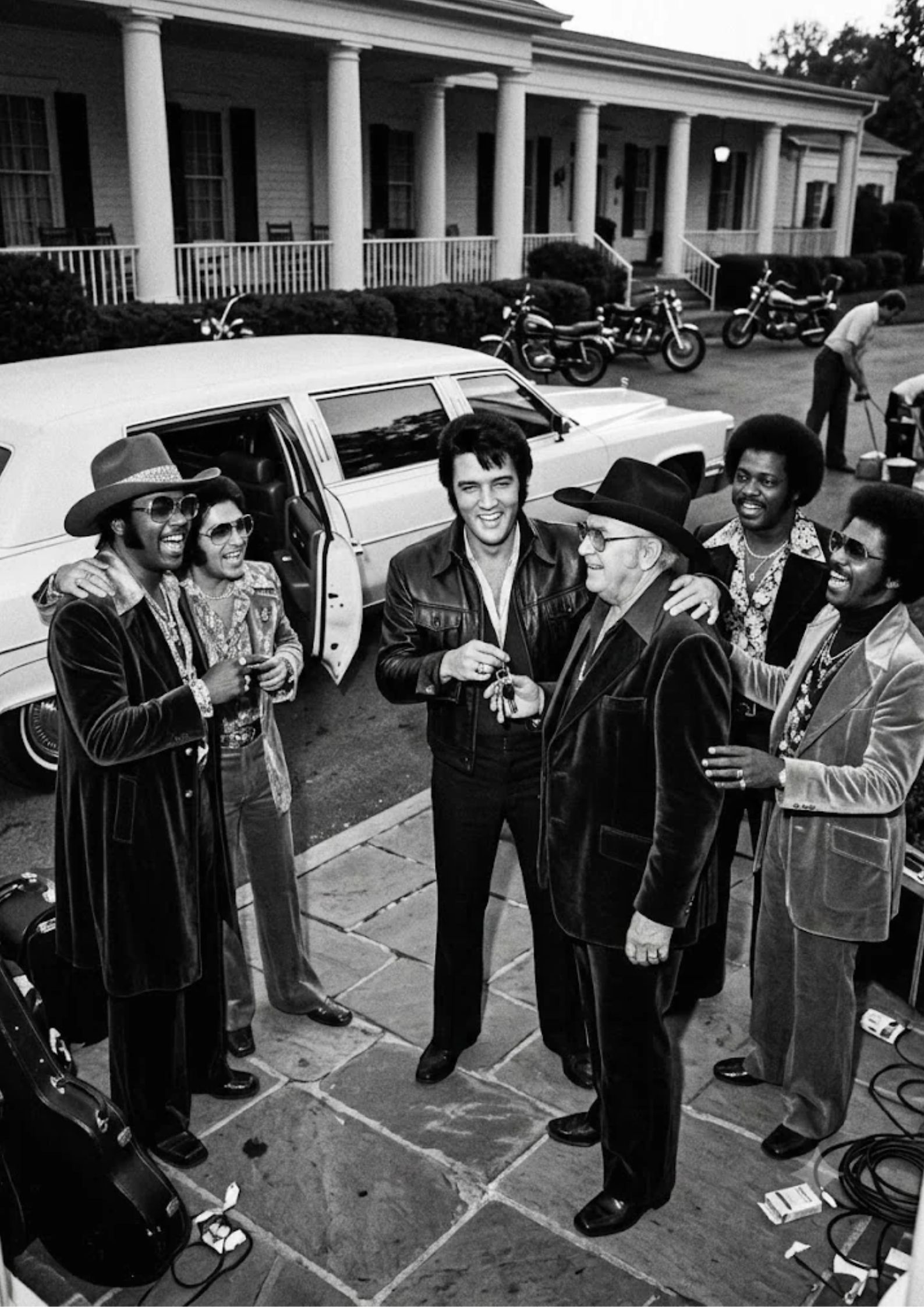
Yet, as quickly as tension mounted, Presley pivoted to absurd comedy. Mid-session, he commanded the entire backing group upstairs to raid his custom wardrobe, personally styling the veteran musicians in flamboyant, floor-length fur coats, wide-brimmed hats, and silk shirts modeled directly after the blaxploitation classic Super Fly. Even the deeply devout gospel singers of the Stamps Quartet were transformed into garish funk caricatures, collapsing the room into fits of hysterical laughter.
As dawn broke over the Memphis estate on the final morning of the sessions, the mania transformed into Presley’s trademark, jaw-dropping benevolence. Noticing the exhaustion of his collaborators, Elvis immediately chartered private aircraft to fly exhausted players back to their families. Then, stepping out onto the cobblestone driveway, he turned to gospel icon JD Sumner, handed him the keys to a pristine, brand-new white stretched limousine parked outside, and told the stunned quartet that the luxury vehicle was theirs to keep.
Behind the chaos, sonic brilliance somehow survived. Those manic late-October nights produced the foundational tracks for what would become his posthumous farewell, including “It’s Easy for You,” “Pledging My Love,” and the infectious bass-driven hit “Way Down”—the final single released during his lifetime.
Today, the October 1976 sessions stand as a haunting portrait of Elvis Presley’s twilight. He was an isolated monarch holding court in a gilded fortress—alternating between heavy weapons and high fashion, chaotic sabotage and astonishing open-handed generosity. He could terrify a room with a machine gun at 3:00 AM, dress his gospel choir like movie gangsters at 4:00 AM, and give away a limousine at sunrise. In the final act of his extraordinary life, the King proved that even when the music was slowly fading, nobody on earth could orchestrate a spectacle quite like Elvis.