Introduction
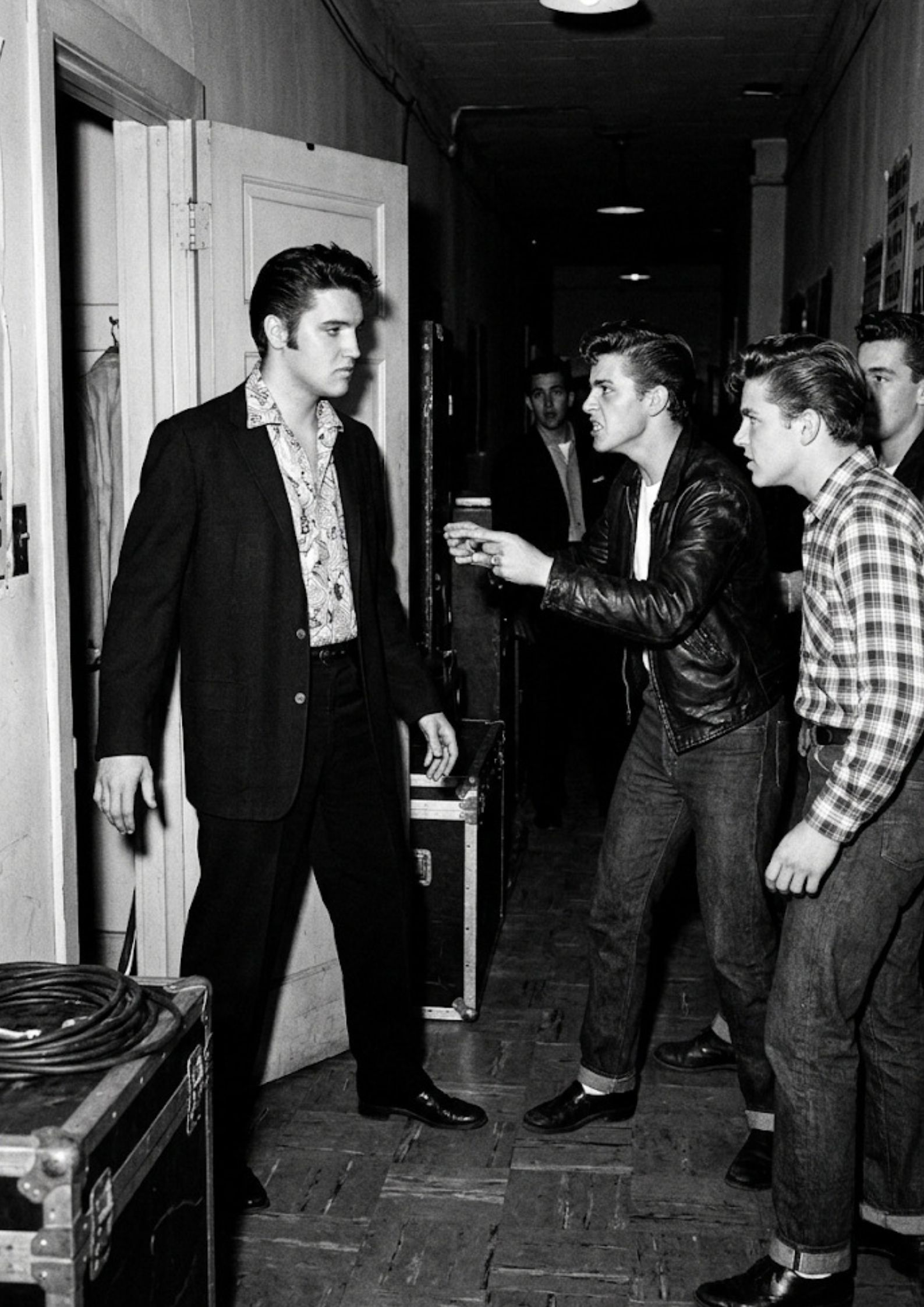
The Fists of a Panther: Backstage Ambushes, Country Rejection, and the Violent Crucible of Elvis Presley in 1956
SPARTANBURG, SC — History remembers 1956 as the year Elvis Presley conquered the planet. It was the year of Heartbreak Hotel, national television hysteria, frantic teenage devotion, and an unprecedented cultural revolution that fundamentally shattered American entertainment.
Yet behind the iconic gold records and screaming auditoriums lay a far more volatile, dangerous reality. To many across conservative post-war America, the 21-year-old Memphis sensation was not an artist to celebrate—he was a degenerate threat who provoked visceral disgust, professional gatekeeping, and physical violence.
In country singer and author Joe Sins’s investigative chronicle, Elvis in ’56, the pristine myth of the King of Rock and Roll gives way to an unvarnished backstage portrait. Drawing from the candid memories of Elvis’s legendary drummer, D.J. Fontana, the record reveals a young man who was forced to defend his life with his fists, even as he quietly navigated the sting of industry humiliation.
Backstage Ambush: The “Panther” of Spartanburg
On February 9, 1956, Elvis and his Blue Moon Boys arrived at the Carolina Theatre in Spartanburg, South Carolina, booked for a grueling three-show marathon at 3:30, 7:00, and 9:00 p.m. His popularity was exploding nationwide, but backstage, hostility hung heavy in the air.
Local youths, enraged by Presley’s flamboyant attire, eyeliner-accented sideburns, and hypnotic sway over their female peers, regularly gathered outside stage doors looking for blood. In Spartanburg, several high school boys cornered the young singer near his dressing room, taunting his appearance and daring him to brawl.
To many, Presley looked like an easy target: a soft-spoken Southern boy dressed in pink and black. They severely miscalculated.
Decades later, D.J. Fontana recalled to Joe Sins over lunch in Nashville that young men constantly attempted to jump Elvis on the road. According to Fontana, Presley possessed extraordinary reflexes and street-fighting instincts, likening his defense to that of a stalking panther: blindingly fast, explosive, and impossible to pin down.
In one startling encounter Fontana witnessed firsthand, Elvis was ambushed by three aggressive men. Before guitarist Scotty Moore or bassist Bill Black could leap in to help, Presley had already leveled two of the attackers onto the concrete floor with brutal efficiency. The third assailant froze in horror, backing down as Elvis stood over them—completely untouched, composure intact.
The image of Elvis as a manufactured studio puppet dissolves under the reality of the 1956 touring circuit: he was a tough, working-class kid who could dismantle grown men in hallway brawls.
A Slashed Face and a Knowing Grin
Later that same night in Spartanburg, an autograph seeker approached Elvis with a souvenir program. On the page, touring country artist Justin Tubb had accidentally signed his name directly across Presley’s printed face.
Where a volatile young star might have snapped, Presley simply grinned, showing the self-effacing warmth that endeared him to his inner circle:
“Old Justin, I need some eyeglasses. He just signed the wrong part of the program!”
The easy laughter masked a profound emotional debt. Justin Tubb was the son of Grand Ole Opry royalty Ernest Tubb—a man whose quiet kindness had once rescued Presley from complete despair during the darkest night of his early career.
The Grand Ole Opry Disgrace: October 2, 1954
To understand Presley’s reverence for the Tubb family, one must revisit an autumn night in Nashville sixteen months earlier.
On October 2, 1954, a nervous 19-year-old Elvis stepped onto the hollowed wooden boards of the Ryman Auditorium for his debut at the Grand Ole Opry. Performing an electrified, blues-infused rendition of Bill Monroe’s Blue Moon of Kentucky, Presley expected acceptance from the country music establishment he had idolized since childhood.
Instead, he was met with chilling silence. Traditionalists viewed his jitterbug rhythms and black rhythm-and-blues phrasing as borderline desecration. Following the set, Opry manager Jim Denny reportedly delivered a crushing verdict, telling the teenager he was wasting his time and ought to stick to driving trucks in Memphis.
Devastated and humiliated, Elvis, Scotty, and Bill Black walked out into the cold drizzle of Lower Broadway.
Wandering into Ernest Tubb’s Record Shop at 417 Broadway, the heartbroken teenager found the country giant himself behind the counter. Rather than dismissing the boy as an Opry reject, Ernest Tubb extended immense grace. He listened to Elvis talk about his dreams, validated his raw talent, and offered the encouraging mentorship the shattered young singer desperately needed to keep going.
Two weeks later, bolstered by Tubb’s kindness, Elvis made his explosive debut on the Louisiana Hayride, igniting the spark that changed music history. By the time he hit Spartanburg in 1956, Elvis was the headliner, sharing top billing with Ernest Tubb’s son—paying forward the grace he had received when no one else believed in him.
The Revival and the Backlash
The momentum of 1956 was relentless. The following day, February 10, Presley played four back-to-back shows in Charlotte, North Carolina. Local newspapers described the mass hysteria as resembling a religious revival, with police cordons buckling under the weight of shrieking fans.
Yet the friction inside the touring camps only deepened. In his autobiography Satan Is Real, country pioneer Charlie Louvin described the combustible clashes between traditional hillbilly artists and Presley’s rockabilly contingent, including bitter backstage confrontations with his brother, Ira Louvin. To the old guard, Elvis was an unwelcome interloper threatening their livelihood.
Country legend Ronnie McDowell, who contributed the foreword to Elvis in ’56, recalled watching Elvis’s first national television appearance that same year: “His voice sounded different from everyone else’s. There was something magical about it.” As Conway Twitty later observed, the television camera reveals an artist’s soul. When the red light went on, the world didn’t see an outlaw or a gimmick; they saw an uncompromising, generational force.
The Crucible of the King
The myth of Elvis Presley often paints his ascension as a swift, effortless stroke of destiny. The reality of 1956 proves otherwise.
He was an impoverished, insecure young man who wanted nothing more than to be embraced by his peers. He survived the contempt of the Nashville elite, navigated explosive backstage brawls, and absorbed bitter hostility from small-town gangs threatened by his freedom.
Through every closed door, thrown punch, and gracious gesture, the 21-year-old was forged in the fire. He didn’t become the King because the industry crowned him; he became the King because neither their rejection nor their fists could break him.
Looking back at the brutal resistance Elvis faced from traditionalists and local crowds in 1956, do you think a revolutionary artist today could survive that level of personal and cultural hostility? Share your thoughts in the comments below!
Video: