Introduction
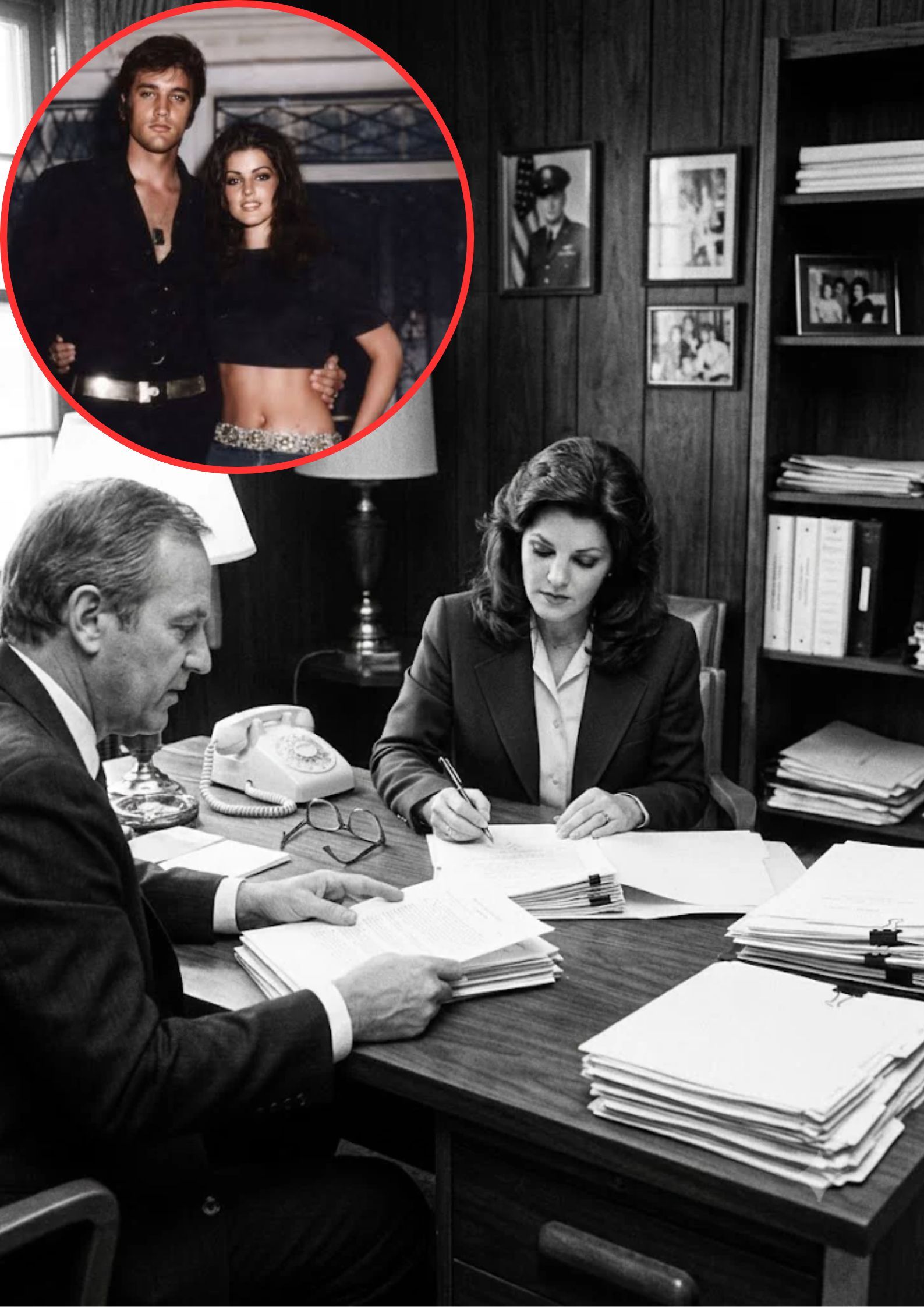
The Zero-Dollar Heiress: The SHOCKING Truth Behind Priscilla Presley’s Fight to Save Graceland
On March 3, 1977, five months before his sudden death at age 42, Elvis Presley signed his last will and testament. When the document was examined following his passing, one detail startled observers who expected a conventional Hollywood legacy: Priscilla Presley was not named an heir. Having divorced the King nearly four years earlier, in October 1973, she was his ex-wife, not his legal widow, and stood to inherit nothing directly. The primary beneficiary was their nine-year-old daughter, Lisa Marie Presley, whose assets were placed into a trust.
Yet, within five years of Elvis’s death, the woman left out of the will held the pen that reshaped the future of Graceland, rescuing a crumbling financial empire from total liquidation.
The public often views celebrity estates through the lens of vast wealth, but the reality confronting the Presley estate in the late 1970s was an impending cash crisis. While Elvis left behind valuable assets—the mansion, real estate, personal effects, and royalty streams—the estate was illiquid. Graceland alone demanded immense annual upkeep, from round-the-clock security and maintenance to steep property taxes.
The initial safety net unraveled rapidly. Elvis’s father, Vernon Presley, who had been appointed executor and trustee, passed away on June 26, 1979. With Lisa Marie still only eleven years old and the principal beneficiary unable to manage an estate, the courts and the trust structure appointed Priscilla as a co-executor alongside a corporate banking trustee and Elvis’s longtime accountant.
Priscilla did not assume this role as an owner or an heir, but as a fiduciary duty-bound to protect her minor daughter’s future. In stepping into this position, she walked directly into a financial minefield, largely dominated by Elvis’s legendary manager, Colonel Tom Parker.
For decades, Parker had orchestrated Elvis’s commercial empire, reportedly taking up to a 50 percent commission on certain earnings. Compounding the estate’s cash-flow limits was a 1973 deal with RCA, in which Elvis had sold off the royalty rights to a significant portion of his earlier catalog for approximately $5.4 million, drastically capping the ongoing catalog revenue available to his heirs. Prompted by an independent investigation on behalf of Lisa Marie, the estate took decisive steps to untangle Parker’s control and challenge existing agreements, shifting the commercial power back to the family trust.
The defining gamble, however, centered on the mansion itself. With advisers proposing that Graceland be sold off to cover ballooning taxes and maintenance costs, Priscilla and the estate leadership resisted. Instead, they conceived a high-risk commercial strategy: opening the private residence to the public and creating Elvis Presley Enterprises.
When Graceland opened its doors on June 7, 1982, it fundamentally transformed celebrity business history. Within a month, the venture broke even; within years, it became a self-sustaining tourism and licensing powerhouse, turning Elvis’s enduring cultural imprint into steady, long-term capital.
By the time Lisa Marie turned 25 on February 1, 1993, and assumed control of her inheritance under the terms of the trust, she did not inherit a bankrupt estate encumbered by debt. She received a thriving, multi-million-dollar empire built from an asset that was once weeks away from the auction block.
The persistent narrative that Priscilla was an outsider maneuvering for personal wealth misreads the documented legal reality. She held no claim to Elvis’s money; rather, she stepped into the gap left by tragedy to defend her daughter’s legacy against corporate exploitation and bankruptcy. In the history of rock and roll, the final triumph belonged not to an heir written into the will, but to the woman left off the page who chose to protect it.