Introduction
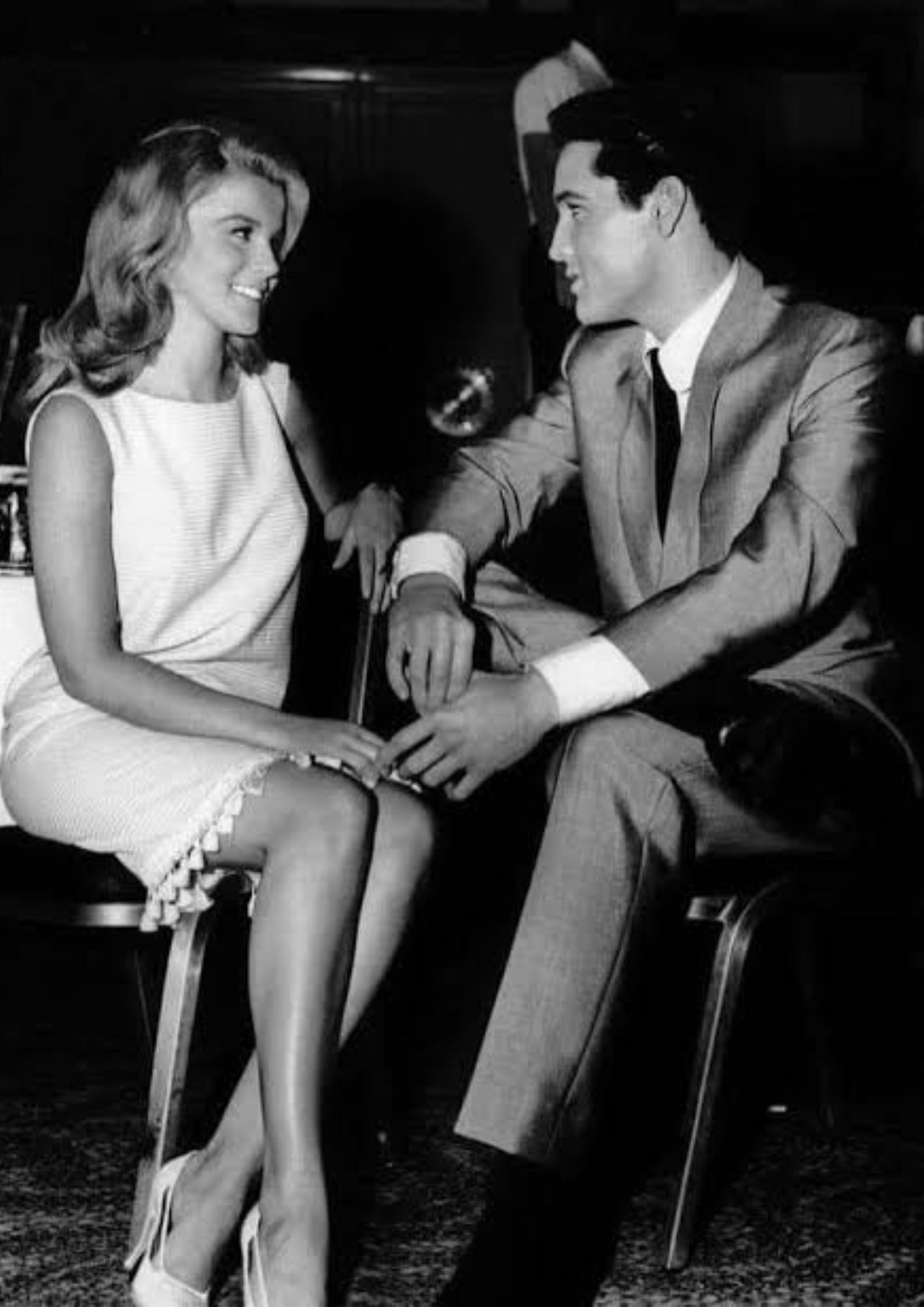
For decades, the world believed it knew Elvis Presley—from his voice and hips to the grandeur of a King. Yet, at 88, Ann-Margret has finally broken her silence, revealing a hidden side that not only rewrites his story, but completely shatters old illusions.
“I do not want to betray his trust… even in death,” Ann-Margret once shared. However, what she chose to recount is not a betrayal, but a fragile truth that the world was never ready to face. Because the real man behind closed doors… bore no resemblance to the image applauded on stage.
The Fateful Moment and the Nickname “Rusty”
It was 1963, on the set of Viva Las Vegas. At just 21 with a magnetic presence, she crossed paths with 28-year-old Elvis, standing at an untouchable peak. Yet when their eyes met for the first time, what connected them was not fame or power, but an uncanny synchronization.
Elvis did not look at her as a prize or a standard co-star. He looked at her as someone he genuinely wanted to understand. Far away from the roaring crowds and the suffocating pressures of the public eye, they found a rare sanctuary—a place where neither had to perform as a superstar.
They talked for hours, not about fame, but about a deep, solitary loneliness. Surrounded by millions, both shared the exact same absolute isolation. He called her “Rusty,” and she called him simply “Elvis.” No titles, no masks—just two souls trying to survive in a harsh world.
The Real Man Behind the Spotlight
The most shocking aspect of Ann-Margret’s confession is how ordinary Elvis was in private, entirely opposite to the icon worshiped by the world. Behind the stage lights, he was introverted, quiet, and more thoughtful than any headline ever portrayed. He read books, asked deep questions, and empathized with the pain of others without needing recognition.
Yet deep inside, an unhealed sorrow lingered. The passing of his late mother, Gladys, had left an everlasting wound in his soul. Ann-Margret did not try to fix it; she simply stayed by his side—and that meant more than anything else.
When Love Falls to the Machinery of Fame
Even the most genuine love struggles to survive the surrounding pressure. Elvis no longer belonged to himself; he belonged to a public image, to fans demanding perfection, and to a management system controlling his every step.
Everything faded away, not through loud arguments, but slowly dying in silence. Phone calls grew sparse, and the effortless connection turned into a burden. By 1967, when Elvis married Priscilla, it officially came to an end. Ann-Margret shed no public tears and fought for no narrative; she simply chose to endure it silently.
When Elvis passed away in 1977, she appeared in black mourning attire, quietly bidding farewell to a man the world never truly understood.
The Truth Behind the Myth
Now, at 88, Ann-Margret is not trying to rewrite history. She is doing something far more powerful: humanizing it. Her speaking out is not to tear down a monument, but to remind humanity that beneath that glittering cape once lived a flesh-and-blood human—a man who laughed softly, loved deeply, and carried silent pain.
And perhaps, what lingers forever is not the fame or the music, but the proof that somewhere behind all the noise of the world, there once existed a love so real it did not need to be brought to light to exist.